If you had told me a few months ago what would happen in Mali, I would not have believed it. The events that have unfolded since the March 21st coup were an awakening. An awakening that Mali was not as stable a democracy that everyone in Africa seemed to think it was and that Mali had fallen the hardest when it seemed the most stable. Since then Mali’s way of life and the uncertainty in government has moved Mali back 20 years. It is unbelievable that one man could change so much. There seems to be little political drama these days and calm seems to be on the surface. The African Union has since disregarded the agreement that was signed with Sanogo giving him ex-Presidential privileges. However it remains to be seen how much power they have to even enforce it. It is easier to give something than to take it away once given. The ripples of dissent are there. People are unhappy with the way things are playing in the North. The latest attack on Mali’s national treasures has caused such anger that it makes me question humanity a little. Mali has gotten more attention from the West with the destruction of Tombouctou’s mausoleums to its Sufi Saints, a UN World Heritage site. If sites/things can get this much attention, how come 250000 displaced refugees cannot get a similar reaction. Have we come to a time in our history where human life is cheap and dispensable but historical artifacts are not?
The refugee situation is becoming worse and the situation will continue to degrade unless the security is restored in the North. People flee when conditions are not safe. The Malian government has been unable to re-secure Northern territory. In addition the destruction on World Heritage sites and the increased punishment under Sharia law has made people desperate. People are so frightened that they are willing to leave homes, land and family behind. Just last week, a woman carrying her baby on her back who was getting water was flogged by Islamists. Her crime? Her head scarf had fallen as she tried to fill water. Today, she and her child lie in a hospital. In other incidents, young men have been flogged for stealing or associating with women. The young men of Tombouctou and Gao are so angered by the situation that they have taken to the streets with clubs and machetes. However while they are bigger in number, they are no match for Ansar Dine’s men that are equipped with guns. Something has to happen soon from the Government of Mali. We cannot lose the future of Mali. Ansar Dine has proven its original mission of its own state to ensure the Tuareg’s well-being is polluted with an agenda of terrorism.
In yet another move to progress Mali back to democracy, Prime Minister Diarra advised ECOWAS of a roadmap to ending Mali’s two big issues: terrorism in the North and ability to hold credible elections after the one year transition. There is talk of creating more opportunities for political actors from other parties so that government can indeed be more diverse. Diarra has said that he would welcome the 3000 ECOWAS troops only if they were to rid the North of terrorists. If all is kept on schedule and the new plan accepted then Mali would be on course to hold elections in May 2013. One of the biggest issues in Mali today is most political parties feel excluded from the government; hence instead of supporting Diarra they are constantly opposing his policies. If a government were created that held no majority, while it would bring in differing agendas, it will also give political parties the chance they seem to be asking for to make a difference. Hopefully, it will not become yet another political circus. Yeah has constantly called for a national unity government to be formed but has also cautioned against furthering personal agendas. He said in a recent debate:” When a nation is faced with its survival it must act in unison. The quarrels of interest will always exist but the existence of our territorial integrity must come before our partisan interests”.
Many people have asked us whether we plan on dropping out of the campaign. Giving up on Mali is not an option for us. Our efforts will be focused on making sure the right things happen for the Malian people in terms of getting refugee aid and contacting governments to advise them of how they can help.
It is essential that national unity be achieved first so that international support will return. Then a better equipped army can be deployed that has confidence in their leaders. After that the North can be regained and the terrorists kicked out. If we don’t do that soon, it may be too late. The time has run out and enough is enough. Once security and safety returns to the region, the refugees will return home. Mali cannot afford another blunder. We are on the right path, but it is moving slowly
Billy Hesterman, from the Daily Herald in Utah, did a story on the situation in Mali and what Yeah Samake is doing to make a difference. Click on the Link below or read the story posted in the Daily Herald in Utah.
Just this year Mali’s military staged a coup on the national government because they claimed they were not receiving enough support to fight the al-Qaeda supported rebellion in the northern part of the west African country. More than 300,000 Malians have fled from their homes to avoid being ruled by the rebels and the country is losing foreign aid as it goes deeper into conflict.
The country was supposed to hold elections this year in which Brigham Young University graduate Yeah Samake was hoping to take over as the country’s president. But with a major conflict taking place and the government being overthrown by the military, that election has been put off until May 2013 so that the country can get its affairs in order.
Currently an interim government has been established and work is being done to strengthen the army that overthrew the government. But the slow-moving process is leaving people without food and sufficient hygiene supplies while they wait for the military to reclaim areas in the northern part of the country.
Samake though isn’t just waiting for the military to act or for his election to come around, he is trying to do something to bring help to his country. He is in the United States right now giving leaders an insider’s view of the situation. He has met with U.S. Sen. Mike Lee, R-Utah, to brief him on the status of the country and also met with state department representatives and United Nations officials to inform them about his country’s struggles.
“There is significant human suffering going on right now in Mali. People are hungry. They can’t provide meat for their families. They sit and watch their kids and worry about providing daily meat to them. As a father and as a mother that hurts,” he said.
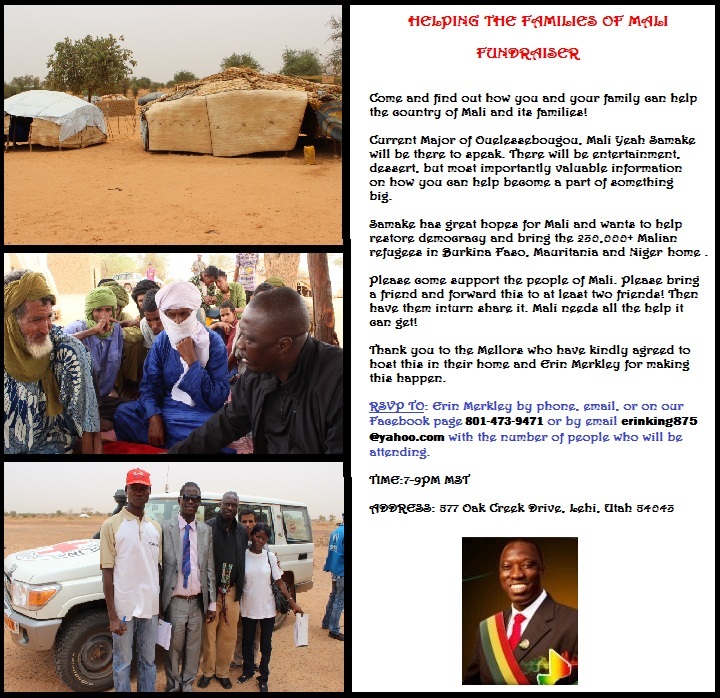
In addition to his briefings to leaders about the status of his country, he also has traveled to Utah to raise money to support the refugees that are suffering in Mali. On Monday he will be in Lehi to host an event that is aimed at raising money and awareness about his people’s situation.
“One of the reasons I am here is to help women and children in those situations,” Samake said. “I’ve been in the refugee camps. I’ve met with the people. I’ve talked with the Red Cross and UNHR and have tried to find the needs of the people. Truly food shortage is significant. But tents are lacking, as well as hygiene kits. And the children that are out of school, they also need a playground and toys to play with.”
So far local businesses have stepped forward to support Samake in his efforts. Nu Skin and Overstock.com have offered their support to him and Lehi resident Erin Merkley is organizing the Monday night event that is open to the public to help support those suffering in Mali. Those wishing to attend the event should contact Merkley at erinking875@yahoo.com.
“Utah can make unique contribution to this because of the connections and ties that so many Utahns have with Mali,” Samake said.
Samake remains hopeful for his country’s future. He also remains optimistic about his chance of becoming the country’s next president. He hopes his current efforts will show the Malians that he genuinely cares for his country and that he has the ability to get things done to get his country on the right track.
“People are looking at me. And this struggle is an opportunity for me to rise up as a leader for my people to see what I can do for the country,” he said.
Just more than 14 million people live in Mali. The annual salary of a skilled worker there is about $1,500. The nation is equal in land size to Texas and California combined.
WANT TO MAKE DIFFERENCE? NOT DOING ANYTHING MONDAY, JULY 16TH? THEN COME JOIN YEAH IN UTAH AS HE SPEAKS ON HIS FIRST EXPERIENCE MEETING THE DISPLACED MALIAN REFUGEES THAT HAVE NOW FLED TO BURKINA FASO.
CAN’T COME? PLEASE TELL 10 FRIENDS IN UTAH ABOUT THIS EVENT. ALSO, IF YOU CAN, PLEASE DONATE ONLINE AT WWW.SAMAKE2012.COM TO SUPPORT THE REFUGEES.
Together I believe we can make a difference in the lives of the refugees that have been displaced. I pray that soon our Malian brothers and sisters will come home. I cannot imagine the conditions they are being subjected to. The shelter they have is no match for the hot, humid weather mixed with rain showers. The food cannot meet the constant pains of hunger. Imagine sitting 15-20 hours without doing anything, day in and day out. The supplies are running out soon and we need to help continue the aid till we can bring them home. This is not a life and I would never wish it even on my worse enemy.
A year ago, do you remember what you were exactly doing? June 17th, 2011 is imprinted very well in my mind. This time last year, I was getting off a plane from the US to Mali for a journey that we believed would change our lives and the lives of the Malian people. We came with the firm belief that Yeah could be the change that Mali needed. We believed he could be a fresh start for a country that was stuck in a rut of bad leadership and corrupt practices. Who knew where we would be a year later. All we knew was the journey had begun and was bound to be exciting.
I remember a year ago, my kids would freak out about flies and bugs. Now, a year later they run after them and catch them. A year ago, they would stick very close to each other. Now, they are making other friends. A year ago, they spoke only English. Now their minds are grasping words and phrases in French and Bambara. Instead of having a family of four, they have added our guards, cook and chauffeur as family. My kids have indeed grown since we came last year.
Politically, Mali too has come a long way. Who knew a year ago that what was one of Africa’s most stable democracies would not only be overthrown but the country would be divided. Who knew that almost 200,000 innocents would be displaced and uprooted from a country they had called home for centuries. Who knew that a year of campaigning would ultimately come down to fighting to restore a democracy instead of extend it. Who knew?
Through the year we have campaigned hard in the 4 corners of Mali. We have seen different cultures and traditions all compiled into a Malian. Mali’s diversity contributes to its beauty and uniqueness and we have found ourselves blessed by it. We have had the opportunity to better know Yeah’s culture and his family. I think his family has accepted us even more as they have gotten to truly know us. We have gotten to understand the challenges that Mali faces. We have been blessed to meet medical missions and people that want to make a difference and come to Mali to do just that.
However, we have also experienced history be rewritten and found ourselves amidst a coup. We have ourselves fearing for our family’s safety and in the prayers of many people that feared for us. We are being given an opportunity to continue to make a difference.
Now that we are here a year later, our resolve is no less strong than the day we started. Sure we have a hit a roadblock, but is a journey worth remembering if there are no bumps? Our people must be brought home. Mali needs to become a democracy again, so the people’s voice may be heard again. But the most urgent dilemma is that the North needs to be rid of terrorists. Mali and all Malians will not and should not be compromised anymore.
This past week has been a huge political muddle. May 22nd was to spell the last day of office for interim President Dioncounda Traoré. A deal brokered by the African nation’s body ECOWAS sought to extend his term for 12 months. Now Dioncounda would have limited powers and the main running of the country would fall in the hands of the Prime Minister Cheick Modibo Diarra.
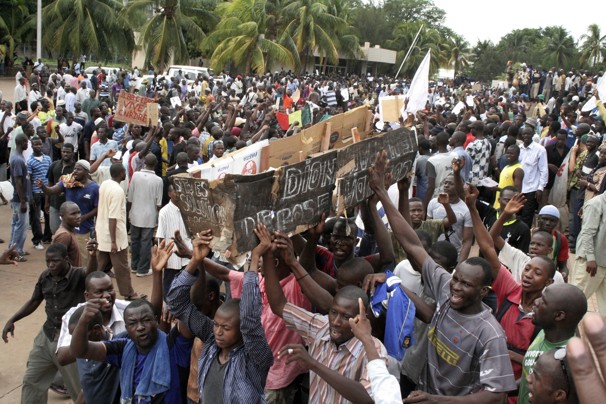
On Monday, protesters unhappy with the forced decision to keep Dioncounda marched on Mali’s palace. There in the heat of the moment, the 70-year old Dioncounda was injured and admitted to the Mali hospital with head injuries. Now people are saying the junta that was supposed to be protecting the President let these protestors in. On the other side, we have also heard that there was a scheduled meeting between Dioncounda and 10 individuals that represented opposing factions. When these 10 individuals came to meet the President and were waved in by the guards, the protesters pushed past as well. Either story while the second may remove the junta’s involvement are hard to corroborate and point to the finer meaning that not even the highest office in the country is safe from protest.
As Bamako watched the news of this attack spread, we were in disbelief. While I am a big believer in democratic process and making your opinion heard, I am also of the belief that human beings need to act like human beings and not animals. In addition, in a society that reveres its elderly, for a 70-year old individual to be assaulted by youth is something that Malians do not take kindly to. That next morning, in secrecy Dioncounda was flown to Paris to be admitted for further testing. That evening, there was another protest held which claimed that Sanogo would be the new President. This protest was only attended by a few 1000 compared to the tens of thousands the previous day. This could mean one of two things. One, many people were shocked that the events of the previous day got so out of hand and also many people felt that Sanogo betrayed them when he took a deal with ECOWAS that bestowed him with an ex-President’s privileges. Sanogo, for his part, other than condemning the violence of the protests, has remained quiet. He as brokered a pretty sweet deal for himself. He would get paid $10000/month (5 million cfa), a house, two cars and a security detail. So the gift he is getting for bringing so much insecurity is very big. In a country so poor, one can only imagine how anyone can get so much money when the average Malian makes less than a $1 a day. The question that also is high on every ones minds is that Sanogo has benefitted but what about the 500+ odd men under the junta. If they feel that Sanogo has betrayed them, then things could get ugly.
This past week Yeah met with the Prime Minister to discuss the ongoing situation. The Prime Minister has condemned the actions of the mob and called on people to be calm using the Bambara word “Sabali” which means “patience” several times in an address to the nation. Yeah also had an opportunity to talk with CNN’s Suzanne Malveaux on the issues in Mali. Take a listen at CNN below. You can also find this on http://samake2012.com/updates/
The North continues to remain in the hands of rebels and the ties that these groups are building are very dangerous to Mali’s stability. Mali’s AZAWAD last week even installed their own President over the North. There has been talk of Mali letting these three regions go. If that happened, I think the outcry in Mali would be huge. These territories not only house the Tuaregs that want their independence but also many other ethnic groups, of which the Tuaregs are a minority. By allowing an independent state to emerge, Mali would be allowing a territory in which groups similar to the Taliban will emerge. In essence Al-Qaeda would be able to get a new playground to harvest various training camps and illegal activities. The entire world will pay the price if the North becomes another Al-Qaeda festering pot. In all this, Malians will pay the heaviest price. With Sharia law already established in Tombouctou, Malians are already being suppressed. Malians in the South need to focus their attentions on the Northern regions. Aid is not the only thing the North needs. It needs freedom from groups attempting to take away civil liberties. If the world wants to get involved it needs to be putting pressure on these groups to pull out. Yeah spoke with CNN’s Erin Burnett about the Northern issue in Mali.
In this entire ruckus, the one thing that remains as forgotten today as it was two months ago is the growing refugee situation. The situation is worse today as the numbers continue to climb. People are living in despicable conditions and while the aid is coming in more now than before, it cannot meet the growing demand. It amazes me that when the earthquake happened in Haiti, the American celebrities put on a great fundraiser and raised a lot of money to benefit Haiti. Probably because Haiti was closer to home. However, the refugee situation has not gained the support of celebrities despite Angelina Jolie being called as a special envoy for the UN High Commission for Refugees. The need is great, the supply is small. Next week, Yeah plans to go to Mopti where some of the refugees are and then later to Burkina Faso. The hope is to assess the growing need and then provide the refugees with some much needed food.
The one thing that never fails to amaze me is the tenacious strength of the Malian people. Through all this, they continue to build their lives, taking in stride the changing forces. As noted before, their faith in their politicians is very low and their belief is as long as the politicians don’t make their lives worse, life will go on. Here it is hard for people to look to the future when their present is so filled with turmoil and hardship. But the Malian people will prevail like they have before. They deserve a much needed break. They definitely deserve better leaders who will give their needs a priority. Mali’s mess cannot be solved by self-serving politicians. It needs honest leadership!
This weekend has been long and relaxing. With Yeah being back in town, we decided to escape the busy political mess of Bamako for the quiet of Ouelessebougou, where Yeah is still the Mayor. The kids have been extremely excited that Yeah has returned, especially Carmen who now has her teasing partner back. However, life did not get less busy for Yeah as his mayoral duties reclaimed his attention.
The changing weather has aligned with the changing political scene. One day it could rain cats and dogs and the very next day the sun shines so brightly that the idea of rain seems unbelievable. However, the rain has brought some much-needed relief to drought stricken Mali and an early start to Mali’s rainy season.
But while the rain is much awaited and much-needed, the changing political scene has brought about controversial debate. On May 22nd, Mali’s interim President Dioncounda Traoré was to step aside and make way for a transitional president as per the constitution of Mali. Many in Mali’s political circle were in favor of a strict observance of the 40-day rule by DioncoundaTraoré because for many he represented the “old guard” that had failed to protect Mali’s best interest and instead lined their own pockets.
Captain Sanogo congratulates Interim President Dioncounda at his investiture ceremony
For a few weeks, there had been much debate between ECOWAS and the junta. For all their claims of giving up power, the junta has been very much involved in Mali’s political scene, going as far as to arrest politicians they believed to be involved in “threats” against the country. It is interesting to note also that in the past few weeks, journalists have accused them of threat tactics like phone tapping and arresting an editor of a local newspaper. The national TV continues to depict a very strong junta involvement, where they can be seen at events representing the government. ECOWAS was never able to provide the junta with a sense of security that nothing would happen to them if they left power. This may explain the junta attempting to maintain a very strong role in the government.
The debate has now been ended at least temporarily. A new deal was cut yesterday between the junta and ECOWAS. The verdict is that Dioncounda will serve the entire transition as the President until elections are held next year. This makes him ineligible to run for office when elections are held. However, who’s to say this will be honored. His role as President will remain merely as a figure-head. The country will be run by the Prime Minister Cheick Diarra and the transitional government. The interesting thing to note is that Sanogo has come out of this deal better off. As part of the deal, he has been given all the privileges that a former head of state would have like a lifetime salary, a home, bodyguards, and amnesty from criminal proceedings. Given that political leaders have not been involved in the mediation process, should a democratically elected president uphold these agreements?
All the while Sanogo has been stating how the Malian people are first and the minute a deal gets offered that favors the junta and primarily himself, he jumps on it. It is to be noted that the junta was under extreme external pressure from countries in the European Union, the African Union and the US. However, a majority of the Malian people have been adamant that Dioncounda not serve the transitional period as President. He has hardly done anything in the 40 days he has been in power. The North remains as divided as ever and if anything, terrorist groups like AQIM and MUJWA are only making themselves comfortable. The refugee situation gets direr every day and the aid is only getting to the boundaries of these captured zones.
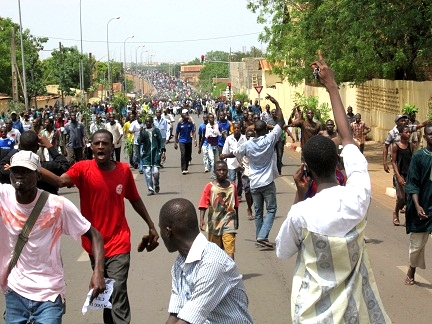
Already, angry protesters have taken to the streets as of Saturday, expressing their discontent with the decision made. Members belonging to groups like APMA and other youth groups have organized a sit in at the monument of independence. Their claim is that they will not leave until Dioncounda leaves power. Today demonstrations continue as people express their discontent. There have been reports of disorderly conduct like burning tires and an atmosphere similar to that after the coup first happened. Dioncounda has been reported to be killed in these protests but there is no verification in that story or the many others that are feeding fuel to the flame. The one thing that is certain is that for most at this stage of the game, it isn’t even about Dioncounda anymore. Many feel like ECOWAS bullied the junta and ultimately most Malians into doing what they wanted done. However some also feel like the junta has let them down by giving in, especially in exchange for favors.
Courtesy of AP reporter Baba Ahmed : Protesters march on the royal palace. Look at the throngs of people
Hopefully, ECOWAS and the international community will correct their mistake quickly for the solution to Mali’s issues needs to come from Mali, not the outside. Only then will true democracy be possible. If the solution is a forced solution where the people feel like Mali’s junta are being held hostage to a decision, then the support will be limited. ECOWAS get Mali’s politicians and leaders involved in our country decisions before it is too late!
On April 12th when Diacounda Traoré was sworn in as Mali’s interim President, the clock started ticking on his 40-day term. His responsibility was to plan when elections would be held and to help resolve the issues of the Northern region in terms of security and the refugees. Diacounda’s inauguration speech was punctuated with severe rhetoric against the rebels of the North, going so far as to even threaten war against them. 30 days into his term, one can clearly see that talk is cheap and that Diacounda has fulfilled very few of the promises that he stated when he was sworn in. This is another reason for Malians to continue to distrust the old guard that has watched over the politics of Mali for the last 20 years.
To be fair, I should say that his task is no easy task. The task remains difficult to reunite a country in which not only the North remains separated by the South, but where different political parties have been reaching out in different tangents. The situation has not been helped by a counter coup attempt by the ex-President’s loyalist forces. Nor has it been helped by threats from ECOWAS on deployment of an army of 3000 foreign soldiers on Mali’s soil to help gain the territory back but more importantly make sure the junta returns to the barracks. These threats have in effect gone against the April 6th agreement between the junta and ECOWAS and have caused great anger among the junta, who see the constitution of Mali being changed by foreigners and power quickly slipping away. By extending Diacounda’s 40-day mandate, the constitution that was quoted when the coup first happened, will in effect be violated. After the whole rigmarole about violating the constitution initially, it seems like a farce for it to now be violated to serve external preferences.
I have seen Diacounda do little in these 40 days other than meet with individuals that cannot influence the course of Mali’s future. The important task of gaining back Mali’s northern territories seem pushed to the back burner. Even more crucial, the refugee numbers have now swelled to 235,000+ with numbers getting higher each day. The US State Department has in effect stated that they hold the junta directly responsible for the mounting suffering of the Malian people. While the junta has contributed to the issue, to blame them whole heartedly seems unfair. There have been many players who could be blamed for the situation in Mali: the old guard ATT, the politicians that have been on the scene for 20-30 years, the junta, the flip-flopping young politicians that go where the power is and also foreign interests.
Now, the one thing that might explain Diacounda’s relative lack of media presence is that the junta still controls the national TV. Each evening the screen is filled with events that seem to embolden the junta’s presence at community events. It is almost as if the stage is being set for them to take over when Diacounda’s 40 days is over. This is something the international community and especially ECOWAS (the body of African countries) would prefer not to happen. By establishing military rule, the junta would be returning the country to a similar period 20 years ago before democracy was established. The events in Mali have already proven that Mali’s democracy was a superficial one with leaders lining their pockets and fulfilling personal ambitions rather than truly answering the needs of those that put them in power. Captain Sanogo, the military leader, has already shown that he has the ability to gain the support from the Malian people that has lacked for so long. However, the constant quashing of the national TV does not bring any comfort and is an early indicator that dissenters could be silenced.
Just last week, I was headed to the PACP headquarters right by ex-Prime Minister Modibo Sidibe’s house. Modibo Sidibé was the one rumored to have stolen a lot of money and used even more to finance his Presidential campaign. He has already been arrested twice by the junta. As I was there, I saw few motorcycles carrying heavily armed guards. They were hunting for Modibo. The first thought that entered my mind was, “Why are you here. Should you not be in the North protecting your people?” It seems more and more that the junta is using the military to advance their personal protection and needs.
Nevertheless, the people of Mali remain embittered by the past 20 years of ineffective democracy and regardless many people see the junta as the lesser of two evils. Especially, since they provide a non-politically affiliated group that ended an ineffective democracy. Sanogo is viewed by many in Mali as a leader, and this is an impression that will not be dispelled anytime soon. I wouldn’t be surprised on May 22nd if the junta reclaims the Presidency and Sanogo remains in power till elections happen next year.
I cannot decide if this is a good thing or bad thing. While this is not an ideal solution, most other solutions will cause further unrest and delay a resolution to the important issues gripping the North. For now, Mali seems to be biding its time with Diacounda, waiting for a true leader to emerge to take the reins of the country. Hopefully the new transition leader will be one that makes more progress than the country has seen in the last 30 days with the least amount of unrest.
10 more days till the hourglass turns once again in Mali to begin the next phase towards determining Mali’s future.
Life in Mali seems to go on without much complaint. Keanen restarted school a week and half ago and thoroughly enjoys it. Even Carmen now is starting to ask when she will go to school, which is a change from a few months back, when the mere mention of the “s” word was enough to induce hysterics. The kids have settled into life in Mali or rather Mali has settled on them. They love the freedom of playing outside (despite the 115F weather) and the walks into the market to buy popsicles. They eat the food with no complaint and honestly seem to be enjoying the people they interact with on a daily basis. That is not to say they don’t miss Utah or the friends they left a year ago. They still talk about them and how they would like to go back and see them. And then the moment passes and they find themselves caught up in another activity or trip to the market. I think that I too have calmed down parent-wise. When I first came here, I worried about where they went and what they ate and how they did certain things. I have been able to trust the perspective what does not kill them will make them stronger. They are good kids, despite their healthy vocal cords and fighting, and I feel blessed to be able to spend time with them.
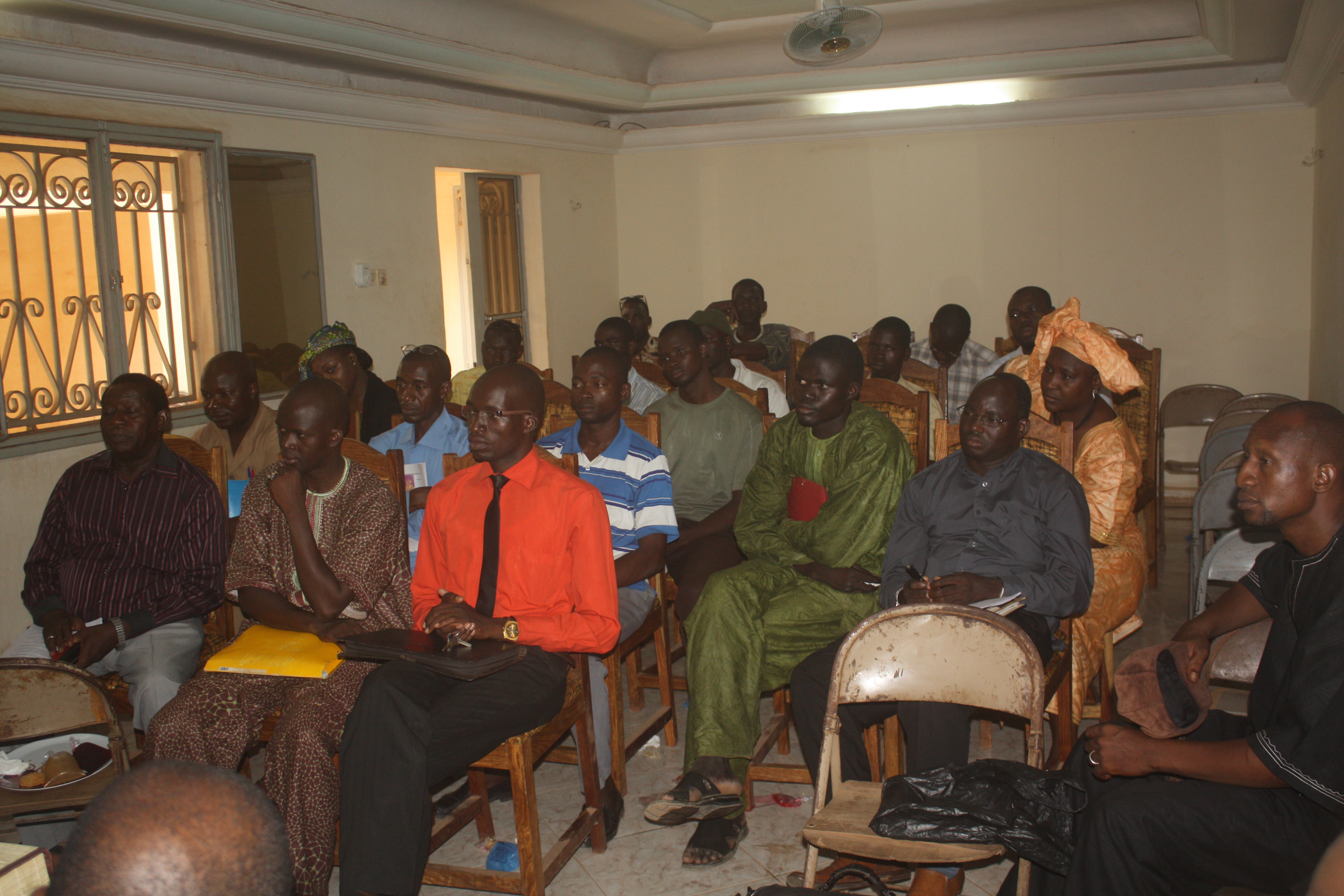
One of many meetings with community leaders
Yeah’s party PACP continues to remain politically active. Now more than ever given the political dilemma Mali finds itself in, it is essential to continue to spread the word about the party and what it stands for. Yesterday, party leaders Fomba and Kone did a leadership training so as to teach community leaders how to spread the word about PACP. By teaching community leaders, they in turn will spread the word and before you know it, there will be a domino effect.
On the political front things seem to be stabilizing. On April 27th, all the ECOWAS members met with the President of Mali and drew up the final installment agreement which decided on the elections and what to do in the North. A positive thing was that elections that were to happen today were decided would happen in 12 months. Two points of the agreement however caused much controversy in Mali today, namely:
“The Heads of State and Government decide to bring the transition in Mali over a period of 12 months, during which presidential elections should be held to choose a new President. The Summit also decided to extend the mandate of the transition bodies, including the Acting President, the Prime Minister and the Government over this period of 12 months to ensure, within the limits of the powers conferred on them by the Constitution, the continuity governance of the country.”
“The Heads of State and Government decide to take all necessary measures to help Mali in the restoration of its unity and territorial integrity. In this regard, the Heads of State and Government instruct the Commission to start with immediate effect, the deployment of the ECOWAS Standby accordance with the mandate approved.”
What the first point in effect is doing is ignoring the 40 day mandate of the constitution and stating that the interim President Diacounda would in essence serve for the coming 12 months. This has been the constant fear that Diacounda would try, like all other “old guard” politicians, to keep his position for longer. To be honest, there is little Malians have seen him do in the 30 years he held positions in the government. The last 10 days since his inauguration has seen him do even less. Other than his meeting with dignitaries, little has been done on his part (in my opinion) to bring the reunification of Mali. His actions belie someone who is unhurried by current circumstances. It is interesting that ECOWAS should ask that Diacounda remain in power for the term of 12 months. Interesting because Yeah had predicted this very thing would happen and a week ago had an article published that asked Diacounda, in the name of patriotism, to step aside after his remaining 20 days, to quick start the transition. (http://samake2012.com/updates/2012/04/le-coq-dioncounda-must-resign-in-the-name-of-patriotism-after-21-days-to-quick-start-the-transition-declared-yeah-samake-of-pacp/). Many political parties, including Yeah’s group ADPS quickly condemned the blatant disregard for the constitution. One cannot just decide to follow the parts of the constitution that are favorable and then change the parts that one doesn’t like. However, that is exactly what seems to be happening by allowing Diacounda to stay for more than his 40 days dictated by the constitution. Captain Sanogo, who led the March 21 coup, was quick to state in an address to the nation, how the junta would not allow such a violation of the April 6th framework agreement to happen. While it is a concern that the junta still seems to have a strong control over the national TV, it feels like the Malian people do have a protector that isn’t afraid to speak out and also let these power-hungry politicians know that Mali is the first priority and the policies that benefit Mali need to be followed.
The second point of day before yesterday’s agreement will allow foreign forces to conduct a military operation on Mali soil. This is a very sensitive issue. The entire problem has started in January with foreign rebels entering the Northern regions of Mali after the fall of Gaddafi, bringing weapons with them. By allowing ECOWAS to fight Mali’s fight with the rebels is continuing to feed the dependency that has made Mali and most African countries dependent on foreign aid. If a war must be fought, the charge has to be led by the Malian troops supported by the foreign forces in terms of weapons and logistics. These ECOWAS troops are not used to fighting in the desert conditions that are home to the rebels and such an operation could lead to the loss of more lives and more chaos.
Indeed it has been a couple of interesting days politically. But in some sense, you can almost see the young Malian politicians stand up and say to the “old guards”—No more. No more breaking the rules just to suit your power-hungry minds. No more putting self before country. No more sacrificing Mali’s sovereignty to please foreign interests. No more changing the constitution that was built on the 300 souls that perished in the previous coup. No more.
Mali is strong. The fight that is being fought is an essential one. Mali needs to find its own identity so that it may in turn hold its own among African nations. To have other nations build its democracy for it will only cause it to fail again.
Vive la démocratie! (Long Live Democracy), Vive le Mali! (Long Live Mali)
As yesterday night passed, so did a deal between ECOWAS and the junta. The consensus concurred with the old constitution that the head of the National Assembly would be named as Mali’s next President. The deal came amidst mounting pressure placed on the junta by economic sanctions.
Within two weeks Mali has not only been further weakened but the number of regions it presides over has been reduced by three. AQIM (an Al-Qaeda branch) and the MNLA have taken over the main regions of Gao, Kidal and Tombouctou. The Tuareg claim is one that has been consistent for the past 50 years going back to when this ethnic group requested their French colonizers to grant them an independent territory. With the return of Gaddhafi’s fallen soldiers that originally hail from Mali, arms have made their demands more attainable. Confusion in the South allowed these groups to take over these three regions in a period of 3 days.
Our Mali divided
This agreement that installs the head of the National Assembly, 70-year old Diacounda, has been received with a mixture of feelings. Diacounda is himself a Presidential candidate and had been pursued by the junta for his alliance with ATT. Malians in general, while they would not want him as a leader, I think, are glad that the sanctions have been lifted. Two weeks after it started and 1 month before elections were set to happen, one could say that the coup seems almost pointless. My concern however is that coups do not happen for “no” reason. They happen because there is an issue within the government. By installing an “old guard”-one from ATT’s regime that allowed many of ATT’s law to pass the legislative body unquestioned, the issue is not being resolved, merely being brushed over because the world says it’s time for the coup to be over. By not resolving the very reason that the coup happened, which is the government’s inabilities and shortcomings in dealing with corruption and the lack of a well-prepared army, we are setting ourselves up for failure. However all Mali can do at this point is to move forward. Yeah will continue to work with his team ADPS to ensure that the voice of the people is heard in the transitional government and that individuals are instituted in the interim that have Mali’s best interest.
So what does this new deal mean for Mali? The good things are that Mali will get the international help it desperately needs right now. Humanitarian conditions are worsening and in the regions captured Malians are being forced under a rule of terror and religious law. We are thankful that our African neighbors are willing to provide boots on the ground to fight the rebels of the North and free our people that are being oppressed. Another good thing is sanctions are being lifted and the economy once again will breathe a sigh of relief as the flow of goods is restored. On the other hand, no time line has been set in place, on when the change of power will happen. The junta promise that it will be soon. Also, the agreement hints it might be impossible to hold elections within 21-40 days as dictated by the constitution because of the attacks on Mali’s territorial integrity. Before elections can be held, territories need to be regained or let go. To clarify, the regions of Tombouctou, Gao and Kidal do not just hold a Tuareg population. These regions hold a higher percentage of Songhai and Peul. So to allow these territories to just “go” as some countries are suggesting would be to deny citizenship to certain ethnicities that have been part of Mali for centuries.
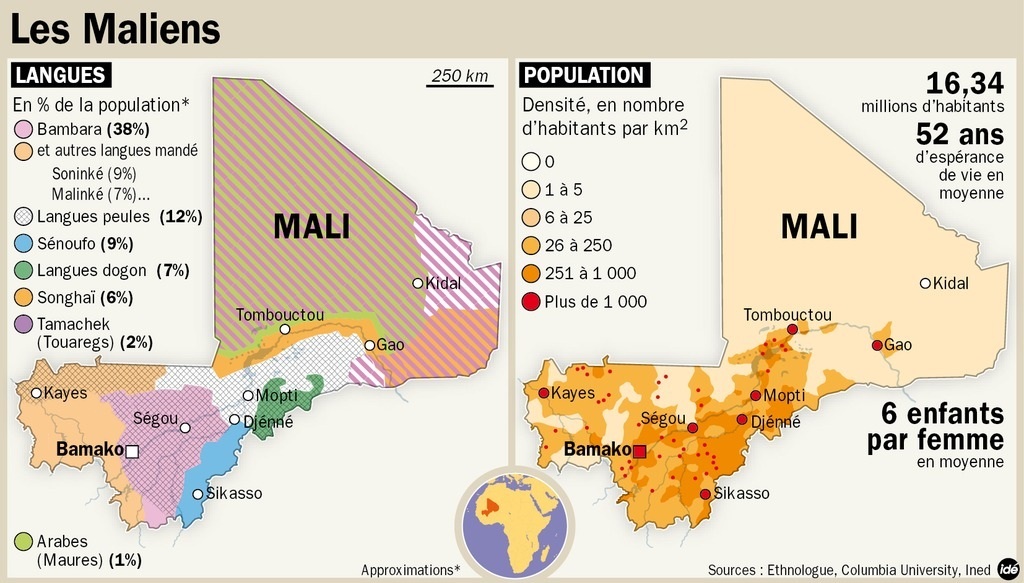
Mali's various ethnicities
All in all there are some steps in the right direction. It is a hope that the humanitarian crisis will end soon and our brothers and sisters in Gao, Kidal and Tombouctou may once again be free. Within the weeks to come the date of the election will be established as a transitional government is put in place.
The election will go forward. Please continue to show your support at www.samake2012.com. We need you with us as we continue this historic journey. Spread the word, the campaign continues! The spirit of democracy in Mali that is Samake2012 lives on!
For those interested, the agreement (translated into English) reads as:
Whereas a return to constitutional normality requires compliance with the constitution of 25 February 1992 which, in Article 36 organizes the Acting President of the Republic in case of vacancy or incapacity.
Mali as it stands today, finds itself slapped with sanctions, its refugee crisis worsening and with the North declaring their independence. I have always maintained that sanctions do not affect governments but individuals. It would take a lot of individual suffering to get Malians on the street protesting against the junta that believe they have just saved Mali from a bigger evil. So why were sanctions issued? Ecowas, pressured by the international community, felt the need to apply sanctions so that the junta would return the country to democracy and the former constitution.
Democracy is one thing, but the former constitution might be a tall order for a number of reasons. Particularly Article 36 of the former constitution.
Article 36 states: When the President of the Republic is temporarily unable to fulfill his duties, his powers shall be provisionally exercised by the Prime Minister.
In case of a vacancy of the Presidency of Republic for some unforeseen, disruptive cause that is an absolute or unavoidable obstacle, noted by the Constitutional Court, and the President of the National Assembly and the Prime Minister, the functions of the President of the Republic shall be carried out by the President of the National Assembly.
A new process for election of a new president for a new period of five years shall then commence. The election of the new President shall take place between twenty-one and forty days after the official recognition of the vacancy or preventative obstacle.
Diacounda Traoré, leader of Adema-PASJ and a Presidential candidate himself, was the President of the National Assembly, before the junta abandoned the constitution. He was also one of the individuals sought to be arrested by the junta. The junta has been wildly popular for the very reason that Malians believe that ATT and top politicians did nothing to serve the common Malian. By putting back the very individuals that have caused harm (in the people’s eyes) would serve little purpose. In addition, Diacounda’s term expires in July. With three electoral regions fallen, it will be impossible for him to hold elections within the 40 days. First the territorial integrity of Mali needs to be restored. Then, Mali can start to plan elections so the people’s voice can be heard.
Yeah and his team, consisting of 10 other political parties and 3 other presidential candidates have formed the Alliance of Democrats for the Patriots out of the crisis (ADPS) or (l’Alliance des Démocrates Patriotes pour la Sortie de crise (ADPS) in French).
ADPS has been working hard to find a solution that is the most compatible with the previous Constitution.
Yeah has been in consistent meetings for the last two weeks trying to come up with a plan politically that can save Mali from further sanctions and loss of territorial integrity. ADPS stance is that there is no way to restore the constitutional order, as it formerly existed because there would be a political deadlock. ADPS maintains that it is impossible for Diacounda to hold free and fair elections before his term expires as per the constitution.
Article 85 states: “The Constitutional Court is the judge of the constitutionality of the laws and it shall guarantee the fundamental laws of the individual and public liberties. It is the regulating body of the functioning of the institutions and the activity of the Public Powers.”
By instituting article 85 instead, ADPS calls on the constitutional court to organize a national forum with the purpose of legitimizing a transitional authority, an intermediate body that is not party bound and that can oversee the return to democracy.
Here are the governing principles of ADPS:
Pass the state power to a body acceptable to all parties subject to validation by the Constitutional Court under Article 85 of the Constitution;
Restore public confidence in the state and strengthen social peace and national harmony;
Strengthen security measures for people and goods, restart and re-deploy the Administration, the economic and commercial activities;
Ensure freedom of speech and press as well as equal access to all state media;
Obtain immediate ceasefire in northern Mali for the total liberation of the country, the return of refugees and tranquility of the people in the northern part of our country;
Avoid isolation of Mali at the regional and international levels and get support from the international community to implement the program of the Transition;
Fight against all illicit trafficking, terrorism and all forms of insecurity in the country;
Reform and re-mobilize the armed forces and security by providing them with adequate means to defend the territorial integrity and national unity;
Preserve the physical and moral integrity of all those arrested during the recent events, release those against whom there would be no charge, guarantee respect for human rights and a fair justice for all Malian;
Democratic elections, free, credible and transparent within a realistic timeframe;
Restore the authority of the State.
ADPS has met with embassies (American, French, and Algerian to name a few) and organizations hoping spread their message. To install Diacounda in power would be almost as if the coup was pointless. The coup was an expression of what every Malian has been feeling for the past few years. The feeling of being marginalized by the powers in office. By installing a transitional authority by the constitutional court as the intermediary body, ADPS is suggesting a fresh start while attaining an end goal of restoring the territorial integrity and also organizing elections in which all of Mali can participate. The regions of Gao, Kidal and Tombouctou need to be won back. Mali cannot do this alone. It needs the help of its neighbors to fight the better armed armies of MNLA and AQIM.
The solution has to come from within. In the countries where the international community has come up with the solution, those countries still struggle with the concept of democracy. Democratic rule of law that fits with the culture of its people are very essential to its success. ADPS hopes that while the international community will help with gaining back territories, but ultimately, the political solution to Mali’s crisis needs to be born on Mali soil and in the hearts of Malians.
ADPS hopes to invite all political leaders to a national forum. The Forum hopes to outline what ADPS espouses but more importantly, hopes that all political parties will put aside their partisan differences and will have one goal only and that is the good of Mali and the Malian people. It is also hoped at the Forum that Malians can together agree on how the transition can be managed, the period of transition and the President of the transition government. Also it will be essential to decide how the three lost territories can be won back effectively and without the loss of lives.
This national Forum is a crucial step in the restoration of national unity, territorial integrity and peace throughout Mali.
Once order is restored, then fair elections must be held. Fair elections are the very heart of democracy. Without free and fair elections, the leader that gets selected becomes a farce to be put up with.
My two cents. I hope that Mali, my adoptive country, will come together and build some consensus on how to resolve the power vacuum and how democracy can be successfully restored. We cannot blindly assume that things should return to the way they were two weeks ago. Things happen for a reason. The coup happened for a reason. That means something was not working. Now is Mali’s chance to rectify the thing that wasn’t working. To go back to the same situation would be to repeat the mistake that was made. If we do this, in 20 more years we will find ourselves at the same crossroads and no closer to a solution. Let’s get this right so that Mali as a whole can truly once again become the beacon of democracy it should be.
UN PEUPLE, UN BUT, UNE FOI ( ONE PEOPLE, ONE GOAL, ONE FAITH) IN OUR COUNTRY MALI
The past week has been an eye opener to not take things for granted. A democracy that had become the beacon and lesson for other countries in Africa was pulled to its feet. As the world watched, a coup led by junior army officers brought down the soldier of democracy himself, Amadou Toumani Toure (ATT).
Much of the Western world has responded in addition to the surrounding African countries requesting a swift return to democracy. The US, EU and ECOWAS have issued sanctions and in some cases threatened them if democracy does not return. So why is democracy so important? Democracy is a relatively fresh concept for many Africans and even at that those countries that have democracies and have elected leaders, eventually find themselves distanced from the very leaders that they put in power. Democracy which entails the formation of policies and determination of state’s role becomes a hard sell in general for so called young African democracies that do not see an exchange of this sort at the local level. In order for democracy to succeed and truly be embraced, leaders need to involve their constituents in running the government. Constituents need to see how laws passed affect them at a local level. For democracy to succeed, local participation should not only be hoped for, it is essential.
Mali had been a democracy for 20 years. The one thing that weakens a democracy like no other is when there is a vast difference between the elite that make the rules and the majority of Malians. Mali has been independent for 52 years, but has seen little improvement in healthcare, education and the poverty standards. Despite an influx of NGOs, unless the Malian government takes a personal stance literacy will stagnate at 46%. 1 doctor will continue to serve 20000 people. The average life expectancy will remain 52 years—almost 30 years shorter than the average Westerner. A huge percentage of the population will continue to live below the international poverty line of 1.25USD a day. The biggest challenge remains the institutions that have been created to resolve these issues. In addition, while great foreign investments have happened in terms of infrastructure, Mali has seen little investment to enhance its primary strength in the agricultural field. 70% of Malians work in agriculture; however, changing climate and the demand on food has made Mali very dependent on importing a majority of its food. More investments need to be made to make Mali self-sustainable and profitable in the agricultural arena.
The new leader will have a plateful of challenges.
Teaching a man to fish: Education needs to be an important part of a new Mali. Today with 46% of the population literate, Mali has very few Bachelor degree holders and even fewer Master degree holders. Very few PhD holders will ever return to Mali because of the lack of opportunity. The new leader will need to increase the number of schools in the rural areas; pay teachers better and make education mandatory. Today, children are favored to work in the fields rather than in the classroom because the first option yields an income for the family. By providing incentives to children and their parents to enroll in school as well as making schools accessible, education can become a reality for many Malian students. Yeah hopes to build 1000s more schools as soon as he comes into office as well as hiring more teachers. He hopes that each region will have its own university and that the strikes that have ravaged the educational systems since 2009 can be resolved with better pay and more investment in the student’s future.
The healthcare situation in Mali is despicable. The average Malian finds healthcare unaffordable and unreachable. With the life expectancy very low and the death from preventable diseases very high, Yeah hopes to build hospitals in every region. Ouelessebougou will have its first hospital in the area that will house a maternity center, pharmacy and eye/dental center. In addition, it will be important to make Mali a safe haven for medical expeditions that come to serve the people of Mali. Through our years we have been blessed to meet many giving hearts and hands and we hope that they will continue to come and bless the people that need it most in Mali.
Jobs: Malian people are not asking for a handout. No one likes to beg and Malians are no exception. However, circumstances currently do not give much choice and it is hard to pass a street without seeing a hoard of hungry children or a mother with a baby on her back and another two in her hands. An important task will be to create jobs for the individuals graduating and also those in the unemployed middle class. Mali’s unemployment is gauged around 30% and is evident in the streets where young men sit hoping that opportunity knocks. Yeah has been able to create jobs with the hospital, school and solar panel field. Also with the cotton plant reopening in Ouelessebougou, 100 more individuals have a paycheck.
A security issue: The north is becoming more and more an Al-Qaeda battle ground. The issue of sovereignty has existed for a few centuries with the Tuareg feeling unappreciated and unaccounted for in a government they elected. The only reason Al Qaeda stands a chance in Mali is that our youth are desperate for opportunities. Normally our people are not prone to radicalization. The Tuaregs in the North believe they have been marginalized—that the government is not serving them.
All these things can only be instituted if you have a government that is not riddled by corruption and institutions that are run effectively and efficiently. Many current government institutions are riddled with inefficiencies and bureaucracy.
Democracy is not lost. This is evident in the opinion polls where 74.5 % prefer democracy to any other regime type. However it has been hit hard in Mali. More than half of Malians feel that government has not served its purpose. Malians for the most part believe government is there to make their lives better. Lives have not gotten better.
Once the immediate security threat of MNLA is crushed, it will be important to start creating stability for our Northern brothers and sisters and also creating opportunities in the North for the refugees displaced by all the fighting. Then it will be important to return to the democratic process and allow Malians to truly choose their candidate unbiased by money and favors.
I truly believe that Malians need a leader with a vision. I truly believe that they need young blood that has been untainted by lives lost and the people’s money stolen. I believe the people of Mali will find a leader who cares in Yeah Samake. Yeah has been distraught over the current crisis that has gripped Mali. Today he told me:” My heart is crying for my country”. I hope that the leaders that are running the country today will work with the international community to end the Northern rampage of MNLA. I hope that international organizations will not forget my people suffering the North. I hope and pray that democracy will be restored temporarily with an interim government and then with free and fair elections. But most of all, I hope Mali will get the leader it so desperately needs that can show his people that there is hope and that Mali can be a great country not made great by foreign aid but by Malians themselves.
Democracy can be and will be restored. Make your voice heard at www.samake2012.com. Support Samake for Democracy!
Join us on our journey as we attempt to affect change for Malians. On July 29th, we will be running for the 2018 Presidential elections in Mali. Be part of our journey at www.yeahsamake.com
You can also Follow our foundation's work at www.empowermali.org






 Moving Mali Forward