RSS

Tag Archives: Samake2013

Mali Elections Announced!

Mali has received more than its fair share of news coverage this past year. While initially, it was for all the bad things happening in Mali, now there seems to be a light at the end of the tunnel. French and African forces have joined the Malian army to eliminate the rebel threat. While all previous rebel-held territories have been freed, the rebels have melted into the population and the surrounding desert, making it more tedious to find them. However, the forces are not taking this task lightly. Security must be restored fully so that these rebels cannot start up again once the foreign troops have left. The Islamist threat in Mali has been a wakeup call to the world. The reality is the world cannot afford to have a country at the mercy of the Islamists.  And we got into the hands of the Islamists, not because the people of Mali believe in this, but because the government failed them.  The hopes and dreams of the people have been completely drifted because of the lack of government support.  So we have to rebuild the institutions, we have to give the people of Mali a leader that believes in embracing all religions, embracing all of the democratic values, and making sure that development and the basic services are provided for the benefit of each and every citizen of Mali.

It will be essential that Mali’s military be rebuilt. The last 10 years has seen all foreign money intended for this purpose being used by the leaders to line their pockets. The weaponry possessed by the Malian army does not even compare with the weaponry a homeowner would have in the West.

So what’s next for Mali? While these forces tie up some last minute threats, the attention has now moved to what needs to happen next in Mali’s recovery plan. And that is the elections to choose the next President of Mali.

After almost a year of non-democratic rule, Malians will be given the chance on July 7th to elect their new leader. The way elections are run in Mali is in two parts. The first run off will be on July 7th. If no one party holds more than 50% of the vote, then the two top candidates will run off again on July 21st. The French are already asking the UN to provide election observers to ensure that the vote is fair and the leader will be democratically chosen.

As Mali edges closer to this date, we continue our mission to ensure that elections do happen. This past month has been hectic as Yeah has been flying coast to coast in the US to try and continue to raise awareness to the challenges Mali will face in the near future. More importantly, he is attempting to guide the debate so that key decision makers in the Western world and Mali will understand how Mali can overcome the many challenges it faces and will continue to face for a while.

Yeah had the opportunity to meet with leaders at UN about the intervention in Mali. Last week he was able to attend Congressional hearings about the situation in Mali and meet with leaders like Assistant Secretary of African Affairs, Ambassador Johnnie Carson who emphasized that the US “supports the territorial integrity of Mali.” This is important because the US has remained largely disengaged from operations in Mali, providing only C17s, despite the threat that AQIM could pose to the US in the future.

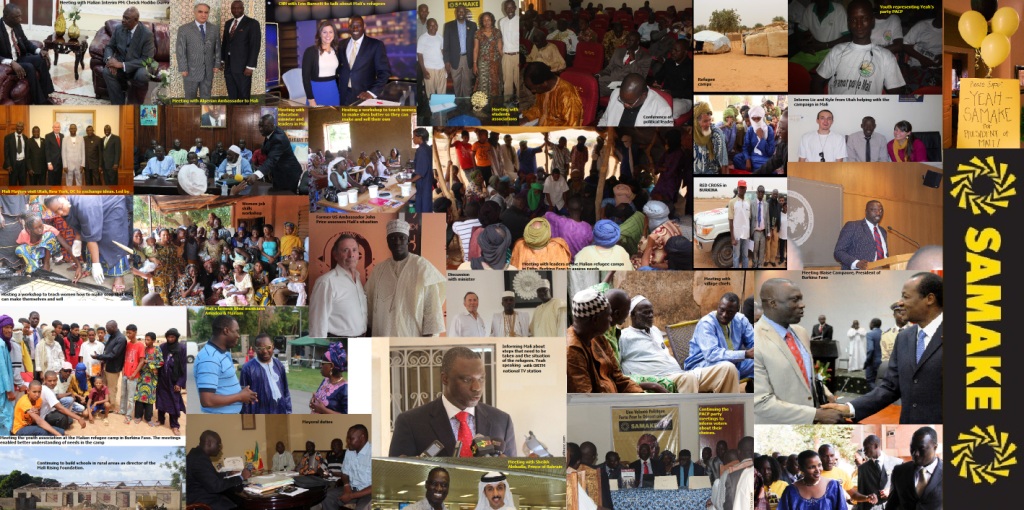
This slideshow requires JavaScript.

Most people are so quick to point a finger at the Mali military for the present day issues. They are quick to state that all these issues started because of them. The issues of Mali have been present longer than the coup. While the military played a role that prolonged the issue, the time had come for the bubbling pot of discontention with Mali’s leaders to boil over. As Yeah advised: “The current crisis in Mali is not a military problem. It is a problem of ungoverned areas, porous borders, weak central government, weak institutions and poor governance, exacerbated by the lack of economic opportunities, tribal or ethnic division, the extremism, anarchy, and a good dose of corruption increasing poverty. If someone tries to tell you that the North is a separate issue and should be treated, isolation is considered too narrow a solution to accomplish what really needs to be done in the long term. The long-term stability, security and peace are the goals, not just a military victory over a group or organization. When you look at the problems listed above, it is clear that a platoon or battalion cannot solve this crisis. Certainly, they can address and support some of them, but first and foremost it is a question of legitimacy and governance.”

The #Mali Moment is now! If Malians wait longer to hold its leaders accountable, the time for change will pass. If Malians don’t elect someone who is honest and truly has done a lot for the country, then we will see the last 10 years of leadership replayed again. This is an opportunity to actually turn the page on the old political class and renew this class with new ideas.

Yeah is the man for the job. We believe that Mali needs the honest, innovative leadership that Yeah can offer. As Yeah has so often stated, “With exceptional skills, valuable experience and moral principles that I have acquired, I am prepared to make Mali a land of freedom, opportunity and prosperity. As a leader, I will promote the belief that it is in the spirit of entrepreneurship, local governance and citizenship that Mali will find his illustrious colonial prosperity.”

We cannot do this without your support. You may not be able to vote for Yeah. However, the resources you donate will help us fight for Mali to hold clean, effective elections.  Help us to share our message of hope and our aspirations for the people of Mali.

They deserve to see the day when they are free of the burdens of poverty and poor leadership. They deserve to see the day when their children are educated and not lose them due to poor healthcare. They deserve better paying jobs and a stable economy. But most of all they deserve a leader who can make all these things possible.

They deserve Yeah Samaké!

MALI WITH YEAH SAMAKE AT THE HELM

MALI WITH YEAH SAMAKE AT THE HELM

Find out how you can be part of this incredible journey at www.samake2013.com.

You can keep current on our journey on my Facebook page: http://www.facebook.com/pages/Marissa-Samake-Journey-in-Mali/263354780407524 Twitter @marissasamake and this blog!
 
1 Comment

Posted by on February 19, 2013 in Past Posts


Tags: , , , , , , , , , , , , ,

Moving Mali Forward

The last month has certainly been one filled with challenges for Mali. In a way, however, the events that have played out and the results broke the deadlock and inaction in Mali.

On January 6th 2013, rebels took over the town of Konna and started an offensive that predicted doom for Bamako, the seat of the Malian government. If Bamako had been overtaken, Mali as we know it would become Al-Qaeda’s newest playground. The French reacted immediately to the threat and deployed troops to secure the South and then in a bold move, together with the Malian army they pushed the rebels back. First Gao, then Tombouctou and finally Kidal. While Kidal still remains in question since MNLA is controlling it, other rebel groups like AQIM are reportedly not present. The French are refusing to get involved in Kidal and maintain that talks need to happen between MNLA and the Malian government. MNLA is mainly made up of Tuaregs from Mali’s northern region. This might explain why France wants to distance itself from getting involved in a civil dispute between MNLA and the government of Mali. However, it also “rumored” that France has in the past supported the MNLA. Nevertheless, the sentiment among a majority of Malians is that the MNLA exacerbated the initial issue in the North by teaming up with other rebel factions like Ansar Dine and AQIM (The Al-Qaeda faction in Northern Mali).Most Malians feel that no negotiations should happen with MNLA. However if Mali is to succeed, talks must definitely happen with the people of the North to ensure that they do not continue to feel marginalized by the people/government of the South. This issue runs deeper and is old as Mali’s independence.  

Now that Mali is once again whole, another serious issue is the refugee issue. It has been reported that the refugee count now stands at 350000 refugees in bordering countries and 200000 plus refugees inside Mali. When Yeah had visited the refugee camps in Burkina Faso last month, there was a woman whose main plea was to return home. Conditions in these camps are terrible and there is not enough supply to meet the growing demand. With the regions in the North now secured, refugees can start to return home. However, there is fear because of an increased report of reprisal killings by the military. Since it was mainly the Tuareg leaders that deserted to the rebel factions there has been a backlash against this ethnic group. In addition, many of the rebels have simply melted away into the desert and also the civilian population, a very common guerilla war tactic. While one can understand why the reprisal killings are happening, these issues need to stop. There needs to be a level of discipline and leaders of the army have strongly addressed that their members need to focus on securing the areas and protecting the citizens.

The faster elections happen, the better chance Mali has of starting its recovery and ensuring its growth and stability. Democracy will also reopen the doors to the West where all negotiations had broken down since a military coup derailed elections and split the country.

Hope has returned to Mali. People are returning back to a way of life they knew a year ago. The past 12 months has affected not only the North, but people in the South too. I hear certain groups condemn the French for interfering, but what they don’t understand is if the French had not intervened Mali today would be the hub of Al-Qaeda and within arm’s reach to Europe, the Americas and Asia. That threat had to be stopped and instead of sitting and discussing it like other countries in the world, the French acted with quickness and agility. The war has been temporarily won. However the battle for restoring a nation back to stability is on.

Now, more than ever, I believe in Yeah’s ability to lead his nation. Mali’s issues are many and the country is probably in a worse off state than at its independence. I believe Yeah has the ability to restore true democracy in Mali and rebuild the economy. I believe Yeah is the hope for the dawning of new opportunities, better life and security for the Malian people.

MALI WITH YEAH SAMAKE AT THE HELM

MALI WITH YEAH SAMAKE AT THE HELM

If you believe like I do, then please support us. A donation to the campaign ensures that our work can continue. Now more than ever it is essential that democracy be returned to Mali. A donation can be made online at www.samake2013.com

Also, this past week, Yeah shared his opinion on what Mali must do to now move forward. His opinion was published in the Washington Times. You can access it at this link or read below: http://www.washingtontimes.com/news/2013/jan/28/the-way-forward-for-mali/

THE WAY FORWARD FOR MALI

“It is critical to stability in the Maghreb and the Sahel region that terrorism in Mali be dealt with, both militarily and politically. The current situation in Mali cannot be separated from the issues in the Maghreb and the Sahel.

Extremists are breaking down the traditional tribal cultural bonds that have held society together in the Sahel region. This breakdown has far-reaching consequences for future generations. If we do not begin to reverse this trend immediately, we will have an exponentially greater problem to deal with in the near future, and much more serious long-term effects. It is critical that we apply equal pressure across the entire region in order to deal with terrorism.

As French forces have promptly intervened to help avert the movement of Islamists toward the south of Mali, there is a growing concern that the militants will spread into neighboring countries. Regional forces have been deployed alongside the French troops, which gives hope that the military campaign will succeed. There is also hope that the United States might soon restore direct political engagement with the Malian government.

The recipe for restoring and maintaining a democratic Mali requires holding elections, the return of Malian administration and army in the north, political stability and accountability, and the homecoming of displaced Malians. The way forward in Mali will begin with a Sovereign National Conference similar to that of 1991. This national dialogue will put in place the right political environment as a precursor to free and fair elections. Malians have a tradition of picking leaders through electoral processes, not by consensus, even when the outcome is less than perfect. When the country is unified, the authority of the state will need to be strengthened to allow cohabitation with decentralized local governance.

We must also consider the humanitarian situation. Humanitarian efforts should be balanced with the need for displaced Malians to return to their homes. They have been driven to camps because they do not want to live under Shariah law. After a successful military intervention, it is important politically that they become part of the solution by returning to their residences. Humanitarian assistance must be balanced in this regard.

There is a legitimate and valid need for the international community to continue to engage on the holding of elections. The current transitional government has shown no great eagerness to hold elections that might remove them from power. Deadlines must be established and commitments to those deadlines. Leverage can be found for both the military and political solutions required to restore Mali to a fully functioning democracy.

Recovering the north is not merely a logistical support effort. In the post-coup environment, there are still some political levers that need to be applied. Support for the Malian army requires not just logistics and training, but also restoring some of our critical relationships.

A group of generals ousted in the coup could play a critical advisory role in retaking the north. In particular, the former Malian Joint Chief of Staff Lt. Gen. Gabriel Poudiougou had a good working relationship with Maj. Gen. David Hogg, commander of U.S. Army Africa, and is well respected by the U.S. Embassy. He was recognized to be a good player with U.S. Army Africa and had not been tainted by some of the corruption that was apparent elsewhere. He should be brought back into the process of taking Mali forward militarily. It is imperative that some of this lost leadership be leveraged back into the process.

The political and military process must be inclusive, not exclusive. This inclusiveness in a small area will be necessary for the political aspects that must drive the re-unification of northern Mali.

Accountability must be the principle that underpins our support. Political corruption was what led to the coup. Military corruption followed that political corruption. As Mali receives material support, it is imperative that the United States, as a major stakeholder in the process, should have a mechanism in place to monitor the flow of this equipment and material to ensure that corruption does not subvert the effort.

Deadlines for an election tied to material and other support for the military effort, along with necessary reforms, will start us down a productive path toward restored democracy and reformed accountability. This road is complex, but it is worth traveling, and it is a journey that must begin immediately.”


Leave a comment

Posted by on February 2, 2013 in Past Posts


Tags: , , , , , , , , , ,

Mali’s future

The year 2012 has been a challenging one for Mali. Mali is already the second poorest nation in the world with issues in many sectors like healthcare, education and government. And if that is not bad enough, the coup last year has made matters worse. While Sanogo seems nowhere in the picture, it is not hard to see that not much happens without his approval. The Interim President Dioncounda is a President in name and more power lies with the Interim Prime Minister Django Sissoko, who so far seems as ineffective as his predecessor. December 2012 saw the resignation of the previous Prime Minister Cheick Modibo Diarra as allegations circled that he was advancing his own political agenda instead of focusing on resolving Mali’s territorial integrity and helping prepare Mali for elections. After months of negotiations, the UN Security council finally backed a resolution to send an African led force to Mali to unseat the rebels in the Northern regions. Unfortunately we have seen more Islamist attacks on areas that were previously held by the Malian army. Yesterday, it was reported that there was an intense battle in the town of Konna, a small town by Mopti.Today reports show that the Malian army was able to successfully regain control of Konna.

So what does 2013 hold for Mali? One only has to be living among Malians to know that Mali is suffering internally. While Sanogo was hailed as a hero immediately after the coup, public opinion in his favor is starting to waiver. The cost of day to day goods has risen significantly and in an economy that already had a 35% unemployment rate before the coup, things seem bleak. Tourism has suffered dramatically and many hotels/restaurants are feeling the pinch. The people in the North are suffering under the imposition of Sharia law. In addition, the refugee crisis seems forgotten. It has become an issue that has been put on the back burner while Mali’s inefficient government tries to figure where it is going and what it is doing. Yeah’s most recent trip to the camps in Burkina Faso last week revealed degrading conditions. One woman in the camp told Yeah that the refugees were tired of the situation and the conditions and just wanted to return home. A home of a united Mali, not a North run by extremists.

The international community is requesting elections in April 2013. Is this doable? Many politicians, who were running prior to March 2012, have now been imprisoned or have fled the country in fear of the junta. The large parties have had to find replacements that are relatively new and unknown. In addition, some of the prior candidates are serving in the current interim government making them ineligible to run in the next elections. Finally, much of the collected campaign funds were utilized prior to the coup and so more fundraising needs to happen to replenish this fund to campaign. Despite these reasons, it is good to see that many of the old corrupt politicians are nowhere in sight to run in the next elections and that much of what is left are younger politicians with newer ideas on how to improve Mali.

However, if we don’t have elections soon, we will not have a government that is recognized as a true democracy. When you have too many players determining policy, fighting to regain the North will become harder. When you have a central leader recognized and elected by the people and a government that responds to that leader, then you have a unified front to represent Mali and regain the North. With all the forces involved from the junta to the interim President to the interim Prime Minister, you have too many faces trying to call the shots and assert authority. Elections mean one authority, one government and a stronger face against terrorism. So if that means April, we will have to be ready.

Mali cannot afford another failed government. I believe strongly, that Mali needs leadership. The issues to date have been caused by a lack of leadership. First, by the former President ATT who was overthrown and who for 10 years failed to raise the level of living. Then by Sanogo who let key parts of the country fall to rebels, while he asserted control. Then by a puppet government which has not truly led. We need to look at what is being done for Malians. While so-called Malian leaders were floundering in their self importance, it was Yeah who was meeting with other Malian politicians trying to reach a consensus on where Mali needed to go. It was Yeah educating key African and Western figures on understanding the situation in Mali from Mali’s perspective and about what was needed for Mali. It was Yeah who was bringing attention to the refugee crisis and reaching out to external organizations to send food and medical care.  Malians need a leader who isn’t self serving. They need a leader that has proved that a Malian’s life is more important than lining their own pockets. Now it is just a matter of allowing Malian voices to be heard so that free and fair elections will be held.

People ask me all the time. Why are you here? Aren’t you afraid for your family, for Yeah? I would be a fool if I said I did not fear for my family and Yeah’s well-being. I do worry, but if we don’t take this opportunity to make a difference, then the fate of 15 million people lies in the balance. Our comforts and tension is nothing compared to the suffering that Malians undergo daily.

The only hope for Mali now is to hold elections and create a strong, unified government. If Malians continue to hope the solution will come from outside, it will be too late. The economy cannot take another year of bad news.

I believe that Yeah can bring change. I believe that this campaign is not about just becoming President of a country. Rather I believe that this campaign has become a quest to restore integrity to a nation and bring hope to a people that are suffering. Too many years have passed with the Malian people being marginalized. Things need to change. Yeah possesses the skills, education and integrity needed to lead Mali. He possesses the strength and diplomacy to unify the government and restore his country.

If you believe like I do, then support us. Become a part of Team Samake and see how you can help us in 2013 to unite a country and raise hope for the people of Mali. www.samake2013.com

The Samake2012 year in review

The Samake2012 year in review

 
3 Comments

Posted by on January 11, 2013 in Past Posts


Tags: , , , , , , , , , , ,