This past month, my driver Zhu added a baby boy to his clan of 10 kids. The name he gave to the boy was Niankoro Yeah Soumaoro, in honor of Yeah. It made me reflect about the importance of names, especially last names, in Mali and one of the finer distinctions of the Malian culture. In Mali your name means everything.
Mali is a culturally diverse country comprised of many ethnic groups. The Bambara form the majority group and their language is the dominant language in Mali. The Malinke (Maninka) and Khassonke occupy the West. The Fulani/Peul/Fula people are nomadic herders. There are Senoufo and Manianka in the South and Songrai, Dogon and Tamashek in the North. With all this diversity, one can only imagine the cultural richness and different pasts that have been merged into one to give you beautiful Mali. Your ethnicity determines your name. Diallo, Bah, Barry, Diakite, Sidibe and Sangare are all Fulani names while Dembele, Sissoko, Diarra, and Traore are shared among the Malinke and Bambara. Coulibaly is also another common last name. My last name, Samake, is a common Bambara name. Certain family names are also best known for certain things. For example, the Koites are griots, record keepers of Mali’s rich history. Dansockos and Bagayoko are best known as blacksmiths.
The most interesting part, however, are joking cousins. Sinankuya is the relationship between “sinankus” (joking cousins). In Mali, it is common to hear joking insults based on your name. It is believed that in the 13th century, King Sundiata Keita created the joking cousins as a way to reduce tensions between the different clans and ethnicities. Who knew that it would carry this far and is one of the reasons for the peacefulness between Mali’s many ethnic groups today. The insults may appear childish to a foreigner, but to truly master them is a sign of cultural integration and acceptance. Bean jokes are very common. You might wonder what is so funny about beans. Well, beans make you pass gas and fart jokes seem to be universally funny. Samake means male elephant and so sometimes you can be teased for being fat like an elephant. Keitas are teased for being peanut farmers. The Coulibalys however are teased by everyone. Even calling someone a Coulibaly is considered a joking insult. When you first meet someone they will usually ask you your last name to determine if you are a joking cousin. A conversation may go something like this:
Me: Good morning.
Coulibaly: Good morning. What is your name?
Me: Fanta Samake.
Coulibaly: YouSamakes are bad. You eat too many beans. You need to be a Coulibaly.
Me: Oh no. We Samakes are good. All Coulibalys are our slaves. You are my slave.
The conversation breaks down at some point mixed with laughter. Conversations like these are common, non-personal and non-threatening, and beautifully unique to Mali. Foreigners who come to Mali are usually given a Malian name. When I first came to Mali, I was given the name Fanta Samake after Yeah’s aunt.
By being able to participate in such a joking conversation in Bambara, I have learned that it quickly gets you farther in Mali. Malians see it as a cultural acceptance of their way of life. There in forms a mutual understanding. And a sense of belonging.
Billy Hesterman, from the Daily Herald in Utah, did a story on the situation in Mali and what Yeah Samake is doing to make a difference. Click on the Link below or read the story posted in the Daily Herald in Utah.
Just this year Mali’s military staged a coup on the national government because they claimed they were not receiving enough support to fight the al-Qaeda supported rebellion in the northern part of the west African country. More than 300,000 Malians have fled from their homes to avoid being ruled by the rebels and the country is losing foreign aid as it goes deeper into conflict.
The country was supposed to hold elections this year in which Brigham Young University graduate Yeah Samake was hoping to take over as the country’s president. But with a major conflict taking place and the government being overthrown by the military, that election has been put off until May 2013 so that the country can get its affairs in order.
Currently an interim government has been established and work is being done to strengthen the army that overthrew the government. But the slow-moving process is leaving people without food and sufficient hygiene supplies while they wait for the military to reclaim areas in the northern part of the country.
Samake though isn’t just waiting for the military to act or for his election to come around, he is trying to do something to bring help to his country. He is in the United States right now giving leaders an insider’s view of the situation. He has met with U.S. Sen. Mike Lee, R-Utah, to brief him on the status of the country and also met with state department representatives and United Nations officials to inform them about his country’s struggles.
“There is significant human suffering going on right now in Mali. People are hungry. They can’t provide meat for their families. They sit and watch their kids and worry about providing daily meat to them. As a father and as a mother that hurts,” he said.
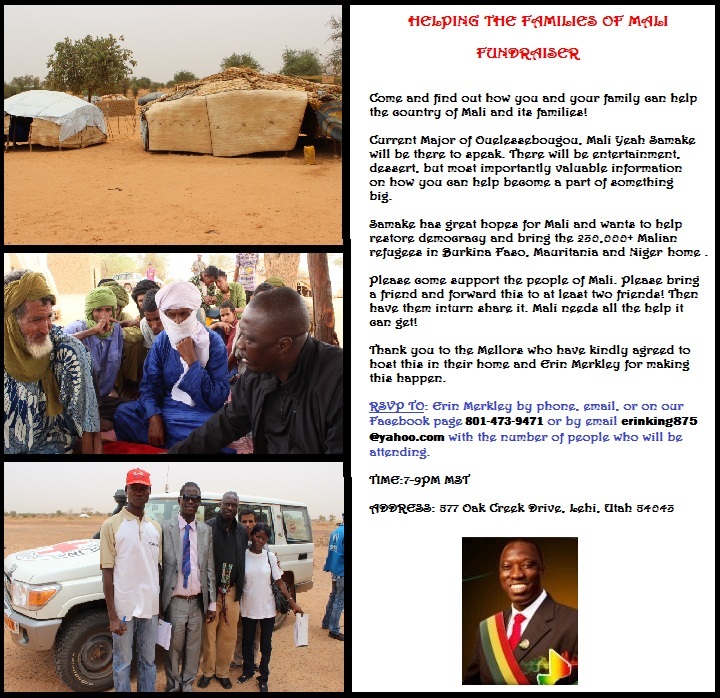
In addition to his briefings to leaders about the status of his country, he also has traveled to Utah to raise money to support the refugees that are suffering in Mali. On Monday he will be in Lehi to host an event that is aimed at raising money and awareness about his people’s situation.
“One of the reasons I am here is to help women and children in those situations,” Samake said. “I’ve been in the refugee camps. I’ve met with the people. I’ve talked with the Red Cross and UNHR and have tried to find the needs of the people. Truly food shortage is significant. But tents are lacking, as well as hygiene kits. And the children that are out of school, they also need a playground and toys to play with.”
So far local businesses have stepped forward to support Samake in his efforts. Nu Skin and Overstock.com have offered their support to him and Lehi resident Erin Merkley is organizing the Monday night event that is open to the public to help support those suffering in Mali. Those wishing to attend the event should contact Merkley at erinking875@yahoo.com.
“Utah can make unique contribution to this because of the connections and ties that so many Utahns have with Mali,” Samake said.
Samake remains hopeful for his country’s future. He also remains optimistic about his chance of becoming the country’s next president. He hopes his current efforts will show the Malians that he genuinely cares for his country and that he has the ability to get things done to get his country on the right track.
“People are looking at me. And this struggle is an opportunity for me to rise up as a leader for my people to see what I can do for the country,” he said.
Just more than 14 million people live in Mali. The annual salary of a skilled worker there is about $1,500. The nation is equal in land size to Texas and California combined.
WANT TO MAKE DIFFERENCE? NOT DOING ANYTHING MONDAY, JULY 16TH? THEN COME JOIN YEAH IN UTAH AS HE SPEAKS ON HIS FIRST EXPERIENCE MEETING THE DISPLACED MALIAN REFUGEES THAT HAVE NOW FLED TO BURKINA FASO.
CAN’T COME? PLEASE TELL 10 FRIENDS IN UTAH ABOUT THIS EVENT. ALSO, IF YOU CAN, PLEASE DONATE ONLINE AT WWW.SAMAKE2012.COM TO SUPPORT THE REFUGEES.
Together I believe we can make a difference in the lives of the refugees that have been displaced. I pray that soon our Malian brothers and sisters will come home. I cannot imagine the conditions they are being subjected to. The shelter they have is no match for the hot, humid weather mixed with rain showers. The food cannot meet the constant pains of hunger. Imagine sitting 15-20 hours without doing anything, day in and day out. The supplies are running out soon and we need to help continue the aid till we can bring them home. This is not a life and I would never wish it even on my worse enemy.
A year ago, do you remember what you were exactly doing? June 17th, 2011 is imprinted very well in my mind. This time last year, I was getting off a plane from the US to Mali for a journey that we believed would change our lives and the lives of the Malian people. We came with the firm belief that Yeah could be the change that Mali needed. We believed he could be a fresh start for a country that was stuck in a rut of bad leadership and corrupt practices. Who knew where we would be a year later. All we knew was the journey had begun and was bound to be exciting.
I remember a year ago, my kids would freak out about flies and bugs. Now, a year later they run after them and catch them. A year ago, they would stick very close to each other. Now, they are making other friends. A year ago, they spoke only English. Now their minds are grasping words and phrases in French and Bambara. Instead of having a family of four, they have added our guards, cook and chauffeur as family. My kids have indeed grown since we came last year.
Politically, Mali too has come a long way. Who knew a year ago that what was one of Africa’s most stable democracies would not only be overthrown but the country would be divided. Who knew that almost 200,000 innocents would be displaced and uprooted from a country they had called home for centuries. Who knew that a year of campaigning would ultimately come down to fighting to restore a democracy instead of extend it. Who knew?
Through the year we have campaigned hard in the 4 corners of Mali. We have seen different cultures and traditions all compiled into a Malian. Mali’s diversity contributes to its beauty and uniqueness and we have found ourselves blessed by it. We have had the opportunity to better know Yeah’s culture and his family. I think his family has accepted us even more as they have gotten to truly know us. We have gotten to understand the challenges that Mali faces. We have been blessed to meet medical missions and people that want to make a difference and come to Mali to do just that.
However, we have also experienced history be rewritten and found ourselves amidst a coup. We have ourselves fearing for our family’s safety and in the prayers of many people that feared for us. We are being given an opportunity to continue to make a difference.
Now that we are here a year later, our resolve is no less strong than the day we started. Sure we have a hit a roadblock, but is a journey worth remembering if there are no bumps? Our people must be brought home. Mali needs to become a democracy again, so the people’s voice may be heard again. But the most urgent dilemma is that the North needs to be rid of terrorists. Mali and all Malians will not and should not be compromised anymore.
This past week has been calm and Bamako continues to remain quiet after the drama of a few weeks back. The President continues to remain MIA while the Prime Minister continues to try to assert his presence. He does seem to have a lot of opposition from many bigger political parties. The reason is probably because his cabinet that he has picked does not include any political players from these parties. The North remains heavy on many Malians minds. More and more reports are emerging about the rebel players in the North and there seems to be a uncertainty about how the government will be handling the rebel groups. The government has not displayed a straightforward plan despite the talk of the PM that Mali would not give away the land in the North.
Most expat hang outs remain deserted which confirms the belief that many foreigners have indeed left the country. This will have some serious impacts on the economy as many workers/vendors find themselves without the more well off expats.
On the home front, things are well. The kids continue to get used to the changing weather. It has indeed become very hot and despite the increase in the summer showers, the heat is never far off. Electricity remains as iffy as ever with power shortages frequent and long. Just last week we spent two nights without electricity. Kean is doing wonderful in school and I am so proud of him. To help with the challenge of the language we have hired a tutor to help Keanen and me learn French. I wish I had the brain of a child. I can tell you Keanen is making leaps and bounds in French. He continuously surprises me when he chatters to his friend or teacher in French. I have no idea why the French cannot stick in my head. You would think it would be easier given that I know other languages. But no, it continues to remain foreign to me. The local language Bambara is much easier to pick up and something I can comfortably get by in. Hopefully, the tutor will be able to drill the French in.
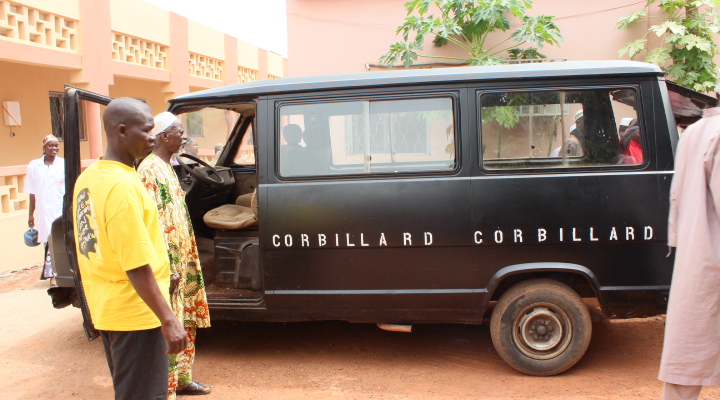
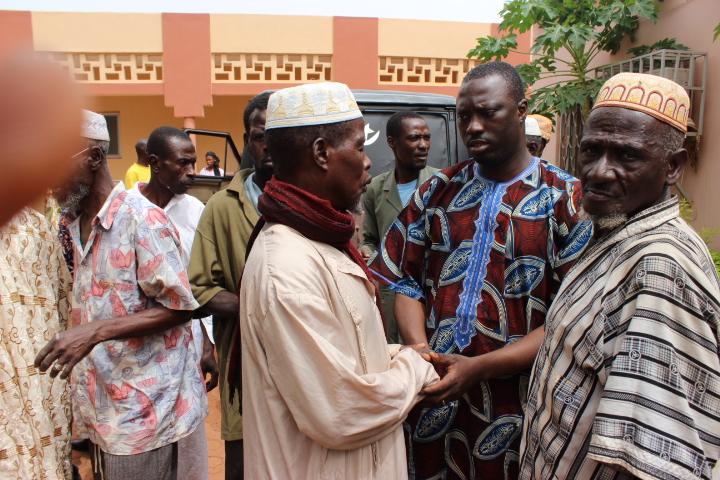
Yeah continues to be busy as ever as Mayor, Director and PACP leader. This past week, there was an inauguration ceremony by the Mayor’s office to donate a hearse to the Ouelessebougou cemetery. As black as this sounds, this will allow the transportation of bodies in a dignified manner. Ouelessebougou is fast becoming a modern city already boasting amenities like running water, electricity and its own bus facilities.
The first hearse in Ouelessebougou
The Imam of Ouelessebougou’s mosque thanks the Mayor’s office for this donation
Party activities continue on a weekly basis as well. Despite the political dilemma Mali finds itself in, PACP membership grows. Their main support comes from the youth and also from individuals like Yeah that are foreign educated and have returned home to Mali. Last week, there was a donation of rice to the residents of Ouelessebougou that were going through difficult times.
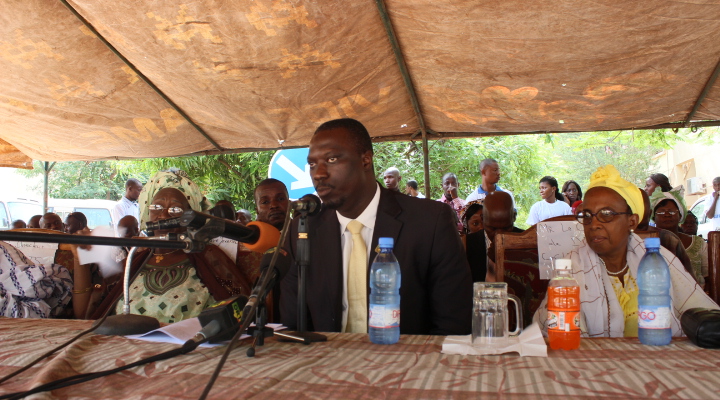
In addition, Yeah continues to work at his foundation MRF. There are two more schools planned for this year. Mali’s education system is struggling at the secondary and higher levels. These schools provide opportunities in villages where children might otherwise not be able to go to school. Just this past week, MRF was honored at The Week of the Students of Social Work in Bamako on June 7th, 2012. The event was held at the Institut National de Formation des Travailleurs Sociaux ( School of Social Work). The theme of the 8th edition of this event was on the humanitarian accomplishments and the guest of honor was the MRF. Yeah, as director, gave a presentation to introduce these students of social work to the importance of activities of a non profit in the field in Mali and encouraged them to work with organizations like this that impact the grassroots level and have the Government’s support. This event, which got media attention in Mali, highlights MRF’s growing importance in the educational and humanitarian arena as well as its visibility in Mali.
A few students of the School of Social Work
Yeah speaks about MRF ‘s work in Mali
All in all a quiet week and an even quieter weekend. Can’t complain about that can we 🙂
This past week has been a huge political muddle. May 22nd was to spell the last day of office for interim President Dioncounda Traoré. A deal brokered by the African nation’s body ECOWAS sought to extend his term for 12 months. Now Dioncounda would have limited powers and the main running of the country would fall in the hands of the Prime Minister Cheick Modibo Diarra.
On Monday, protesters unhappy with the forced decision to keep Dioncounda marched on Mali’s palace. There in the heat of the moment, the 70-year old Dioncounda was injured and admitted to the Mali hospital with head injuries. Now people are saying the junta that was supposed to be protecting the President let these protestors in. On the other side, we have also heard that there was a scheduled meeting between Dioncounda and 10 individuals that represented opposing factions. When these 10 individuals came to meet the President and were waved in by the guards, the protesters pushed past as well. Either story while the second may remove the junta’s involvement are hard to corroborate and point to the finer meaning that not even the highest office in the country is safe from protest.
As Bamako watched the news of this attack spread, we were in disbelief. While I am a big believer in democratic process and making your opinion heard, I am also of the belief that human beings need to act like human beings and not animals. In addition, in a society that reveres its elderly, for a 70-year old individual to be assaulted by youth is something that Malians do not take kindly to. That next morning, in secrecy Dioncounda was flown to Paris to be admitted for further testing. That evening, there was another protest held which claimed that Sanogo would be the new President. This protest was only attended by a few 1000 compared to the tens of thousands the previous day. This could mean one of two things. One, many people were shocked that the events of the previous day got so out of hand and also many people felt that Sanogo betrayed them when he took a deal with ECOWAS that bestowed him with an ex-President’s privileges. Sanogo, for his part, other than condemning the violence of the protests, has remained quiet. He as brokered a pretty sweet deal for himself. He would get paid $10000/month (5 million cfa), a house, two cars and a security detail. So the gift he is getting for bringing so much insecurity is very big. In a country so poor, one can only imagine how anyone can get so much money when the average Malian makes less than a $1 a day. The question that also is high on every ones minds is that Sanogo has benefitted but what about the 500+ odd men under the junta. If they feel that Sanogo has betrayed them, then things could get ugly.
This past week Yeah met with the Prime Minister to discuss the ongoing situation. The Prime Minister has condemned the actions of the mob and called on people to be calm using the Bambara word “Sabali” which means “patience” several times in an address to the nation. Yeah also had an opportunity to talk with CNN’s Suzanne Malveaux on the issues in Mali. Take a listen at CNN below. You can also find this on http://samake2012.com/updates/
The North continues to remain in the hands of rebels and the ties that these groups are building are very dangerous to Mali’s stability. Mali’s AZAWAD last week even installed their own President over the North. There has been talk of Mali letting these three regions go. If that happened, I think the outcry in Mali would be huge. These territories not only house the Tuaregs that want their independence but also many other ethnic groups, of which the Tuaregs are a minority. By allowing an independent state to emerge, Mali would be allowing a territory in which groups similar to the Taliban will emerge. In essence Al-Qaeda would be able to get a new playground to harvest various training camps and illegal activities. The entire world will pay the price if the North becomes another Al-Qaeda festering pot. In all this, Malians will pay the heaviest price. With Sharia law already established in Tombouctou, Malians are already being suppressed. Malians in the South need to focus their attentions on the Northern regions. Aid is not the only thing the North needs. It needs freedom from groups attempting to take away civil liberties. If the world wants to get involved it needs to be putting pressure on these groups to pull out. Yeah spoke with CNN’s Erin Burnett about the Northern issue in Mali.
In this entire ruckus, the one thing that remains as forgotten today as it was two months ago is the growing refugee situation. The situation is worse today as the numbers continue to climb. People are living in despicable conditions and while the aid is coming in more now than before, it cannot meet the growing demand. It amazes me that when the earthquake happened in Haiti, the American celebrities put on a great fundraiser and raised a lot of money to benefit Haiti. Probably because Haiti was closer to home. However, the refugee situation has not gained the support of celebrities despite Angelina Jolie being called as a special envoy for the UN High Commission for Refugees. The need is great, the supply is small. Next week, Yeah plans to go to Mopti where some of the refugees are and then later to Burkina Faso. The hope is to assess the growing need and then provide the refugees with some much needed food.
The one thing that never fails to amaze me is the tenacious strength of the Malian people. Through all this, they continue to build their lives, taking in stride the changing forces. As noted before, their faith in their politicians is very low and their belief is as long as the politicians don’t make their lives worse, life will go on. Here it is hard for people to look to the future when their present is so filled with turmoil and hardship. But the Malian people will prevail like they have before. They deserve a much needed break. They definitely deserve better leaders who will give their needs a priority. Mali’s mess cannot be solved by self-serving politicians. It needs honest leadership!
Mali currently stands on the cusp of a big decision to be made. On one side, a deal favored by ECOWAS would be to allow interim President Dioncounda Traoré to serve the next 12 months as President of the transitional government. On the other side, would be to choose a new president during the transition. Mali remains divided on this decision. Many would prefer Dioncounda to leave office on May 22nd as per the Malian constitution. To many, Dioncounda is a reminder of the “old guard” that allowed things to get so bad in Mali, a reminder that Malians would soon like to put behind them.
On May 21st, in response to a forced decision by ECOWAS to have Dioncounda serve as a transitional President, tens of thousands of protesters marched on the palace and brought harm to Dioncounda, who had to be admitted to hospital for head injuries.
Analysis from Presidential Candidate: N. Yeah Samaké
Yeah has always maintained that the solution to Mali needs to come from inside the country. In a Voice of America interview, he said: “Mali needs its partners, but we need to make sure that this is a Malian solution. We cannot make this solution outside of Mali [because] that will be an imposition. We don’t want that and it is not going to be a lasting solution”.
In response to today’s violence, Yeah stated: “These acts are condemnable. However may it serve as a lesson that there needs to be a concerted effort at a solution that is acceptable to all Malians, who believe the act of choosing a President is a sovereign decision. After the violent reactions to the decision made by ECOWAS, we can anticipate a number of outcomes:
1) Follow the status quodecision keeping Dioncounda as the president of the transitional government as his term as interim President ends today. This means that ECOWAS will choose the interim President who will ultimately honor all agreements during the transitional power. The advantage of this decision will save Mali and ECOWAS from the daunting task of bringing Malians together to have a consensual President. It is also conducive to a quick return to an acceptable, seemingly acceptable constitutional order that is a pre-requisite for involvement of the international community. The drawback of the decision would be the sustainability of the solution beyond the 12 months transition. This decision excludes the participation of political leaders who are ultimately going to become the decision makers to upload the agreements made during the next 12 months.
2) The consensual decision. This implies the organization of a national convention that Sanogo and several political players have called for. This will allow for a consensual transitional body that will be accepted by all involved parties. This alternative will ensure a more stable transition supported by all the stakeholders. As a drawback this option may not be warmly received by the international community. As a result, Mali may continue to receive sanctions imposed by bilateral and multilateral partners such as ECOWAS, US, France, World Bank and the IMF. Ultimately the withdrawal of this support would cripple the country from the capacity to resolve the rebellion in Northern Mali.
3) An elected transition President as suggested by ADPS. ADPS is formed with 14 other political parties and their solution would allow Malian political leaders, civil society, and the junta soldiers to be proportionally represented in a 30-person body. Seven representatives of the military, 18 represented from the political parties and five from civil society. This 30-person body will elect the transitional president in their midst excluding the military representatives. This alternative would take the longest to achieve. It may also not receive the blessings of the international community. However the outcome would be the most compatible with the constitutional order. This alternative will offer the most legitimate form of leadership, where the president is actually elected and the remaining 29 members form the legislative body. The legislative body will replace the current Assembly that is reaching the end of its term. This option will resolve the unpopular decision to prolong the term limits of the Assembly which violates the constitution.
So which one is the best option for the Malian people? At the end of the day, Mali as a whole represented by leaders of civil and political society need to come together and decide. Mali’s future cannot be planned by other leaders and countries who are driven by foreign agendas. This solution has to be about the best for Mali and Mali alone.
Yeah would certainly love to hear your comments on which alternative would be your pick.
On April 12th when Diacounda Traoré was sworn in as Mali’s interim President, the clock started ticking on his 40-day term. His responsibility was to plan when elections would be held and to help resolve the issues of the Northern region in terms of security and the refugees. Diacounda’s inauguration speech was punctuated with severe rhetoric against the rebels of the North, going so far as to even threaten war against them. 30 days into his term, one can clearly see that talk is cheap and that Diacounda has fulfilled very few of the promises that he stated when he was sworn in. This is another reason for Malians to continue to distrust the old guard that has watched over the politics of Mali for the last 20 years.
To be fair, I should say that his task is no easy task. The task remains difficult to reunite a country in which not only the North remains separated by the South, but where different political parties have been reaching out in different tangents. The situation has not been helped by a counter coup attempt by the ex-President’s loyalist forces. Nor has it been helped by threats from ECOWAS on deployment of an army of 3000 foreign soldiers on Mali’s soil to help gain the territory back but more importantly make sure the junta returns to the barracks. These threats have in effect gone against the April 6th agreement between the junta and ECOWAS and have caused great anger among the junta, who see the constitution of Mali being changed by foreigners and power quickly slipping away. By extending Diacounda’s 40-day mandate, the constitution that was quoted when the coup first happened, will in effect be violated. After the whole rigmarole about violating the constitution initially, it seems like a farce for it to now be violated to serve external preferences.
I have seen Diacounda do little in these 40 days other than meet with individuals that cannot influence the course of Mali’s future. The important task of gaining back Mali’s northern territories seem pushed to the back burner. Even more crucial, the refugee numbers have now swelled to 235,000+ with numbers getting higher each day. The US State Department has in effect stated that they hold the junta directly responsible for the mounting suffering of the Malian people. While the junta has contributed to the issue, to blame them whole heartedly seems unfair. There have been many players who could be blamed for the situation in Mali: the old guard ATT, the politicians that have been on the scene for 20-30 years, the junta, the flip-flopping young politicians that go where the power is and also foreign interests.
Now, the one thing that might explain Diacounda’s relative lack of media presence is that the junta still controls the national TV. Each evening the screen is filled with events that seem to embolden the junta’s presence at community events. It is almost as if the stage is being set for them to take over when Diacounda’s 40 days is over. This is something the international community and especially ECOWAS (the body of African countries) would prefer not to happen. By establishing military rule, the junta would be returning the country to a similar period 20 years ago before democracy was established. The events in Mali have already proven that Mali’s democracy was a superficial one with leaders lining their pockets and fulfilling personal ambitions rather than truly answering the needs of those that put them in power. Captain Sanogo, the military leader, has already shown that he has the ability to gain the support from the Malian people that has lacked for so long. However, the constant quashing of the national TV does not bring any comfort and is an early indicator that dissenters could be silenced.
Just last week, I was headed to the PACP headquarters right by ex-Prime Minister Modibo Sidibe’s house. Modibo Sidibé was the one rumored to have stolen a lot of money and used even more to finance his Presidential campaign. He has already been arrested twice by the junta. As I was there, I saw few motorcycles carrying heavily armed guards. They were hunting for Modibo. The first thought that entered my mind was, “Why are you here. Should you not be in the North protecting your people?” It seems more and more that the junta is using the military to advance their personal protection and needs.
Nevertheless, the people of Mali remain embittered by the past 20 years of ineffective democracy and regardless many people see the junta as the lesser of two evils. Especially, since they provide a non-politically affiliated group that ended an ineffective democracy. Sanogo is viewed by many in Mali as a leader, and this is an impression that will not be dispelled anytime soon. I wouldn’t be surprised on May 22nd if the junta reclaims the Presidency and Sanogo remains in power till elections happen next year.
I cannot decide if this is a good thing or bad thing. While this is not an ideal solution, most other solutions will cause further unrest and delay a resolution to the important issues gripping the North. For now, Mali seems to be biding its time with Diacounda, waiting for a true leader to emerge to take the reins of the country. Hopefully the new transition leader will be one that makes more progress than the country has seen in the last 30 days with the least amount of unrest.
10 more days till the hourglass turns once again in Mali to begin the next phase towards determining Mali’s future.
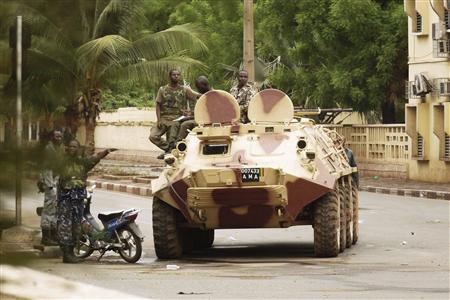
Amidst the dust storms that settled over Bamako, there came news mid evening that gunfire was being reported in the vicinity of the news station ORTM and Kati (the military barracks). ORTM has been at the heart of Mali history in the making for the last month and a half. The first coup happened at ORTM. So what exactly was going on? The loyalists to the deposed president Amadou Toumani Toure (ATT) were reported to have joined forces with foreign fighters to try to defeat the junta and reclaim ORTM. It was interesting to note the changing news stories in the first few hours as journalists reported how first the junta was in control and then the loyalist forces and then the junta again. Interesting because it showed an uncertainty of the rapidly developing situation. The loyalists are known as the Red Berets and are the personal bodyguard of the President, very similar to the Secret Service. It is also interesting to note that when the coup first happened on March 21st, there were reports of the Red Berets launching a counterstrike, but then junta leader Sanogo had come on TV with the Red Berets and said that they were all one and fighting for the same cause.
The Red Berets and junta show a united from on ORTM (March 22)
So why the sudden change of heart? It would be pointless to re-institute ATT as President given his term was essentially done as of April 29th and that most Malians are fed up with his lack luster leadership over the last year. To put ATT in office would essentially cause a lot more trouble than is worth and even ATT, given his recent fleeing to Senegal does not seem willing to put his life on the line. So why now? The past week has seen a number of decisions made by ECOWAS and the interim President Diacounda regarding the length before elections, which has been set at 12 months, Diacounda’s term possibly being extended to 12 months and the deployment of ECOWAS troops in Mali. This has caused some consternation among the junta as the extension of Diacounda’s term is a violation of the Mali constitution and the junta in no way was part of this new agreement which goes against the framework agreement of April 6th. In addition, the junta and most Malians do not want foreigners fighting on Malian soil. What they want is weaponry, logistics and supplies that can help guide their efforts in the North of the country. Today, there was to be a meeting between the junta and ECOWAS to discuss these things. However, yesterday evening, tensions flared first as the student association AEEM attacked the radio station run by Oumar Mariko, a junta loyalist. Red Berets stormed ORTM with the hopes of defeating the junta and soon reports were swirling around about the Berets having taken over ORTM and the airport. As we reached midnight, nothing seemed clear. Reports claimed 14 junta and Red Berets were dead and 40 injured.
This morning, I woke up to rumbling thunder. In the first moments I thought it was gunfire, but then realized that the rain was coming to wash away the bad dust storm that has captured the city. No new news has been reported and in my opinion, no news is sometimes good news. Sanogo came in a recorded broadcast and spoke to the Malian people this evening. He advised that certain foreign militia had teamed up with the Red Berets to try to stage a mutiny against the junta. Sanogo told the Malian people not to worry and that all was well. He was firm and said that none of the governments that have been installed are in danger. They remain and Mali continues to be ruled in effect by an interim President Diacounda, a Prime Minister Cheick Modibo Diarra and the transitional government of 24 members. Sanogo has advised his job is to ensure Mali and Malians remain safe and that the seat of government should not fall. Yeah also called Prime Minister Diarra early this morning to ensure his safety and the safety of the government as the situation developed. There were also rumors swirling about ECOWAS troops being in Ouelessebougou, which Yeah quickly dispelled. The Prime Minister, encouraged Yeah to spread a message to all American leaders he was meeting with. His position is that what happened on March 21st was a mutiny (and not a coup) against a corrupt government and that stability has been restored with an interim President and civilian transitional government. It is the hope of PM Diarra that countries like America will understand that the aid they have continued to suspend is a hard blow to the innocent civilians that need it most. It is the hope that this aid will be restored so Mali can recover quickly.
As it stands now, the airport, ORTM and other key areas are under the junta’s protection. They have also taken over the Red Berets Djicoroni camp. The airport has been shut down not only due to the bad visibility but now the fighting. There are reports of flights operating on the 4th of May. Also, a large amount of guns, grenades and missiles have been confiscated from these armed groups.
The junta has successfully quashed two counter-strikes now and in a way has shown their ability to protect Mali from further falling. Their inabilities in the North are attributed to ATT who never prepared his army to fight an insurgency. All the weaponry provided by the Western governments is rumored to have never reached the soldiers. Sending troops without arms into battle would be sending them to an early grave and risking the lives of 100K people in the region. To many Malians, the junta is their hero, having saved them from being marginalized further by a corrupt, ineffective government.
My two cents. It makes no sense why the Red Berets would launch a counter offensive. It might just be militia trying to make the most of the uncertain times in Mali. That is why it is important now more than ever for Malians to stand up for their country and unite in the face of rebellion. No use turning the clock back. I guess call me the optimist, but Mali is heading in the right direction with the objective being the installation of a leader that will resolve the countries bigger issues like education, the economy and the healthcare system. For now, it will be essential to protect the semblance of the government in place so that calm may be re-established and that the needful may be done like restoring Mali’s territorial integrity. We need to live in the moment. We have to make the most of what has happened and help build a strong foundation upon which Mali’s democracy may grow.
For the past two mornings, Bamakois (people from Bamako) have woken up to an orange shade covering the entire city. It is such an unseen and unheard of phenomenon that I thought it blog worthy.
Yesterday as I and the kids played outside, I did not think or was not as affected by it. Today, however, things have taken a “dusty” perspective. The clothes hanging on the line gained a dust coat and even the leaves outside show a brown instead of the healthy green of two days ago. So where is this dust coming from? No one knows and Bamakois are a little perturbed.
Despite the strange weather pattern, PACP continues its onward goal to spread the word about their plans for Mali. A lot of good can come if Yeah becomes President. His plans for the education system, and healthcare system would bring relief to many Malians who need and deserve better health and jobs.
PACP meeting in Bamako
And while Mali’s problems can be resolved with stable, honest leadership, the dust storm looks like it’s here to stay a bit. This morning as we drove to school, we witnessed numerous motorists with their faces covered and young school children whose heads were covered with scarves. Even at Kean’s school, the usually filled playground was deserted. Hopefully this like all things will pass.
Makes you appreciate that breath of fresh air!
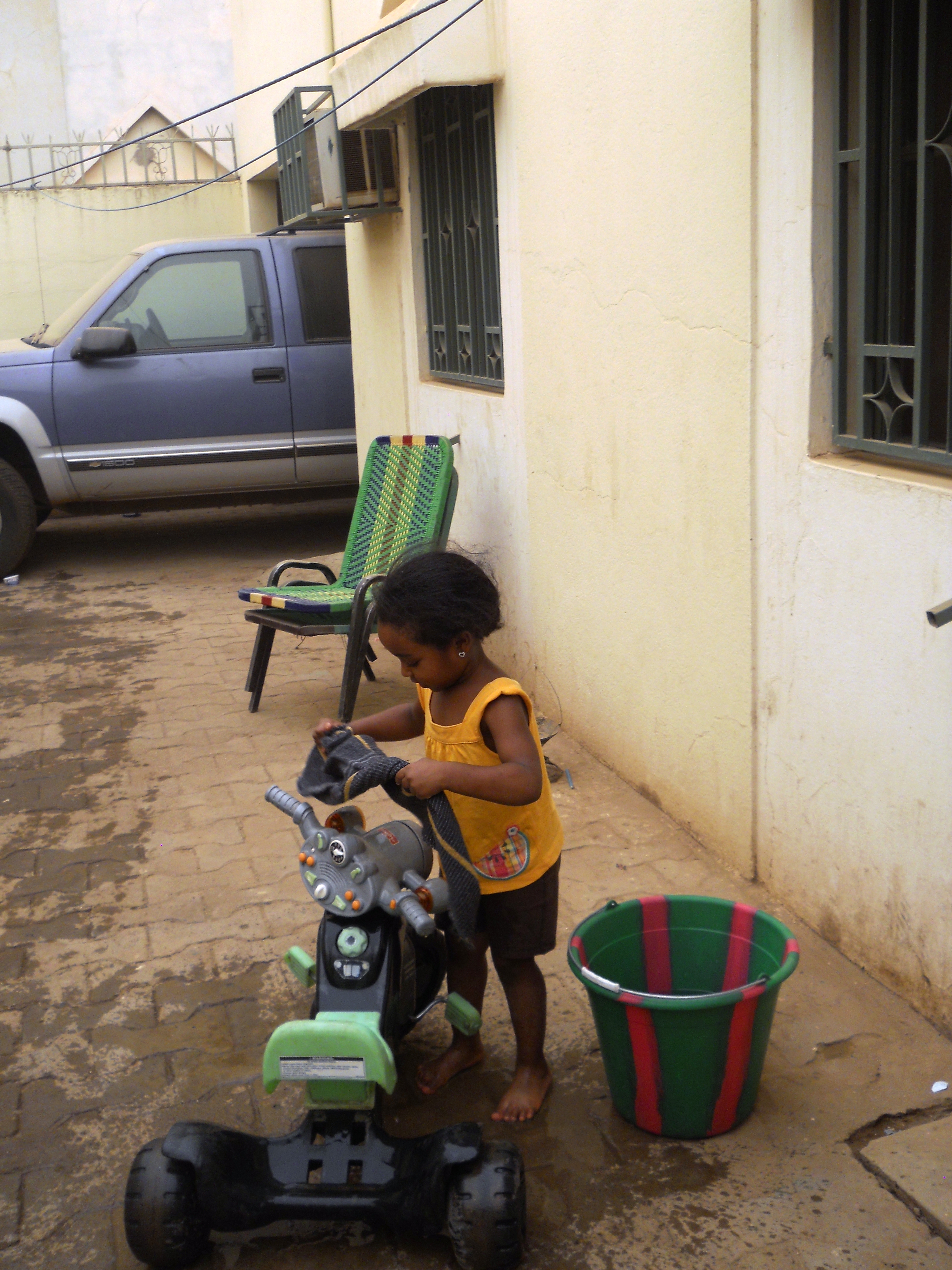
Carmen washing her bike after the dust storm hit last night
Life in Mali seems to go on without much complaint. Keanen restarted school a week and half ago and thoroughly enjoys it. Even Carmen now is starting to ask when she will go to school, which is a change from a few months back, when the mere mention of the “s” word was enough to induce hysterics. The kids have settled into life in Mali or rather Mali has settled on them. They love the freedom of playing outside (despite the 115F weather) and the walks into the market to buy popsicles. They eat the food with no complaint and honestly seem to be enjoying the people they interact with on a daily basis. That is not to say they don’t miss Utah or the friends they left a year ago. They still talk about them and how they would like to go back and see them. And then the moment passes and they find themselves caught up in another activity or trip to the market. I think that I too have calmed down parent-wise. When I first came here, I worried about where they went and what they ate and how they did certain things. I have been able to trust the perspective what does not kill them will make them stronger. They are good kids, despite their healthy vocal cords and fighting, and I feel blessed to be able to spend time with them.
One of many meetings with community leaders
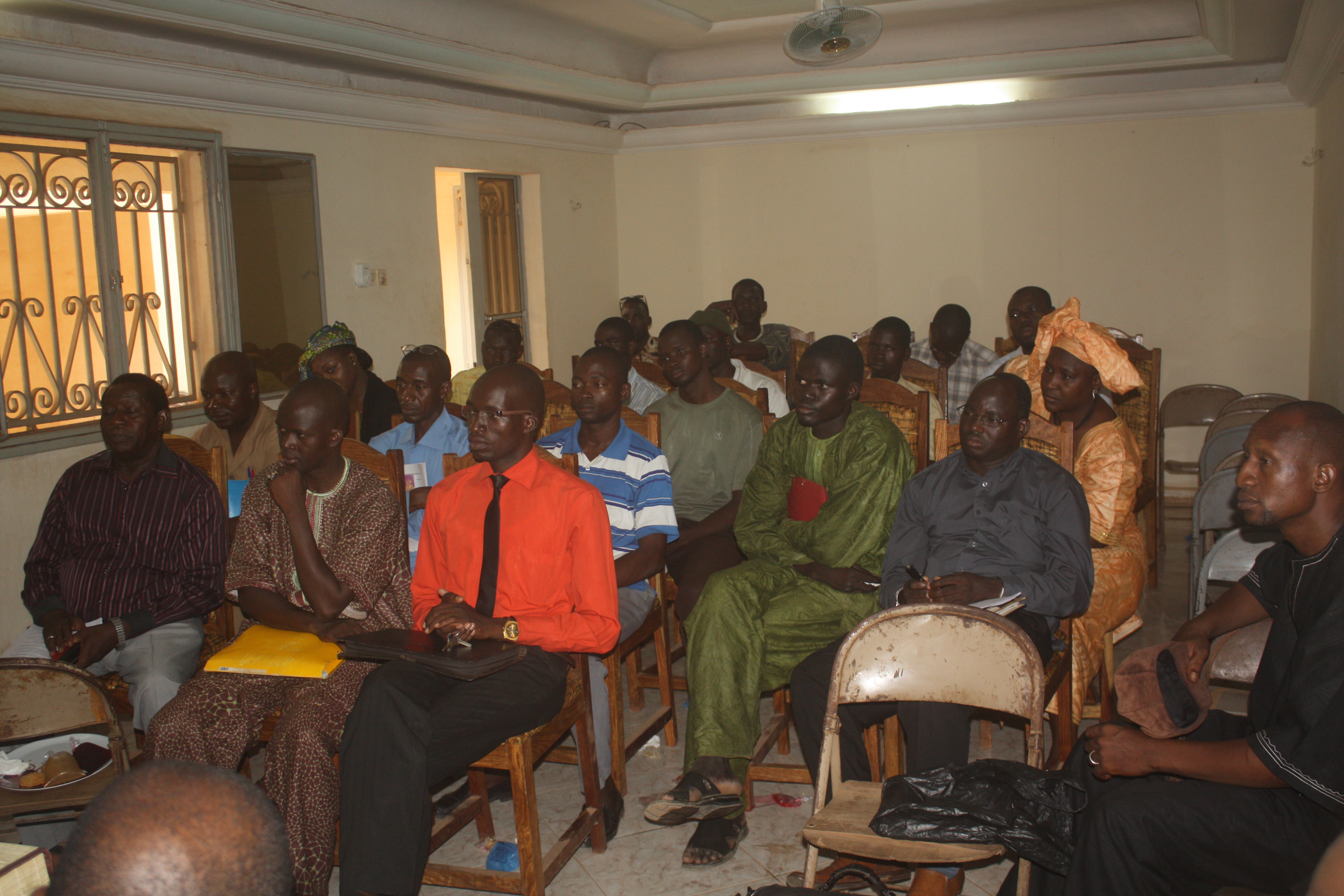
Yeah’s party PACP continues to remain politically active. Now more than ever given the political dilemma Mali finds itself in, it is essential to continue to spread the word about the party and what it stands for. Yesterday, party leaders Fomba and Kone did a leadership training so as to teach community leaders how to spread the word about PACP. By teaching community leaders, they in turn will spread the word and before you know it, there will be a domino effect.
On the political front things seem to be stabilizing. On April 27th, all the ECOWAS members met with the President of Mali and drew up the final installment agreement which decided on the elections and what to do in the North. A positive thing was that elections that were to happen today were decided would happen in 12 months. Two points of the agreement however caused much controversy in Mali today, namely:
“The Heads of State and Government decide to bring the transition in Mali over a period of 12 months, during which presidential elections should be held to choose a new President. The Summit also decided to extend the mandate of the transition bodies, including the Acting President, the Prime Minister and the Government over this period of 12 months to ensure, within the limits of the powers conferred on them by the Constitution, the continuity governance of the country.”
“The Heads of State and Government decide to take all necessary measures to help Mali in the restoration of its unity and territorial integrity. In this regard, the Heads of State and Government instruct the Commission to start with immediate effect, the deployment of the ECOWAS Standby accordance with the mandate approved.”
What the first point in effect is doing is ignoring the 40 day mandate of the constitution and stating that the interim President Diacounda would in essence serve for the coming 12 months. This has been the constant fear that Diacounda would try, like all other “old guard” politicians, to keep his position for longer. To be honest, there is little Malians have seen him do in the 30 years he held positions in the government. The last 10 days since his inauguration has seen him do even less. Other than his meeting with dignitaries, little has been done on his part (in my opinion) to bring the reunification of Mali. His actions belie someone who is unhurried by current circumstances. It is interesting that ECOWAS should ask that Diacounda remain in power for the term of 12 months. Interesting because Yeah had predicted this very thing would happen and a week ago had an article published that asked Diacounda, in the name of patriotism, to step aside after his remaining 20 days, to quick start the transition. (http://samake2012.com/updates/2012/04/le-coq-dioncounda-must-resign-in-the-name-of-patriotism-after-21-days-to-quick-start-the-transition-declared-yeah-samake-of-pacp/). Many political parties, including Yeah’s group ADPS quickly condemned the blatant disregard for the constitution. One cannot just decide to follow the parts of the constitution that are favorable and then change the parts that one doesn’t like. However, that is exactly what seems to be happening by allowing Diacounda to stay for more than his 40 days dictated by the constitution. Captain Sanogo, who led the March 21 coup, was quick to state in an address to the nation, how the junta would not allow such a violation of the April 6th framework agreement to happen. While it is a concern that the junta still seems to have a strong control over the national TV, it feels like the Malian people do have a protector that isn’t afraid to speak out and also let these power-hungry politicians know that Mali is the first priority and the policies that benefit Mali need to be followed.
The second point of day before yesterday’s agreement will allow foreign forces to conduct a military operation on Mali soil. This is a very sensitive issue. The entire problem has started in January with foreign rebels entering the Northern regions of Mali after the fall of Gaddafi, bringing weapons with them. By allowing ECOWAS to fight Mali’s fight with the rebels is continuing to feed the dependency that has made Mali and most African countries dependent on foreign aid. If a war must be fought, the charge has to be led by the Malian troops supported by the foreign forces in terms of weapons and logistics. These ECOWAS troops are not used to fighting in the desert conditions that are home to the rebels and such an operation could lead to the loss of more lives and more chaos.
Indeed it has been a couple of interesting days politically. But in some sense, you can almost see the young Malian politicians stand up and say to the “old guards”—No more. No more breaking the rules just to suit your power-hungry minds. No more putting self before country. No more sacrificing Mali’s sovereignty to please foreign interests. No more changing the constitution that was built on the 300 souls that perished in the previous coup. No more.
Mali is strong. The fight that is being fought is an essential one. Mali needs to find its own identity so that it may in turn hold its own among African nations. To have other nations build its democracy for it will only cause it to fail again.
Vive la démocratie! (Long Live Democracy), Vive le Mali! (Long Live Mali)
Join us on our journey as we attempt to affect change for Malians. On July 29th, we will be running for the 2018 Presidential elections in Mali. Be part of our journey at www.yeahsamake.com
You can also Follow our foundation's work at www.empowermali.org









 Moving Mali Forward