RSS

Tag Archives: www.samake2012.com

Growing support!

Today we mark the two month count down to the elections on July 7th. I am humbled at the out pouring of encouragement and support we have received since we began this journey.

I am very excited to share the latest video of Samake2013. I would like to thank the amazing talented Travis Pitcher and Joseph LeBaron at The Goodline who have yet again successfully captured the spirit of Samake2013 and the hope for a new democratic Mali. These guys are amazing. Check this video out!

This past month we have seen a growing recognition for what we are trying to accomplish in Mali. In Mali, this has meant a growing number of supporters turning up to our weekly meetings at our headquarters and many offices being created in distant regions. Many Malians are starting to seriously realize that change is needed and Yeah Samaké is the man for the job. Our growing fan base on social media and at our office on the ground is proof of that.

It does not stop there. We have had a number of news outlets including TIME cover Yeah’s story and his run for the Presidency. Just this morning Yeah was on the BBC to talk about his candidacy and why he is running to be President of Mali.

Here are some excerpts and the links to some of those News articles. We thank all these media members that have shared the Samake2013 message of hope and democracy for Mali.

TIME: As Mali Wars With Islamists, a Mormon Runs for President by Aryn Baker—“The government failed the people, so the people turned to the religious groups that filled the gaps,” Samaké says, referring to the success of Islamist militias that, for a time, occupied some of the country’s most historic cities. “Any nation that fails its people opens itself up to that kind of vulnerability, and we need to change that in Mali.” Read more

UTAH ABC4: Elections back on track: Mormon leads in race for president in African nation by Brent Hunsaker — “I am here to serve, not to take advantage of the people.” For years, Mali politicians did just that. They grew rich while the people starved. An election was seen as a license to rob. Samaké sharpened his image as a corruption fighter as mayor of Ouelessebougou. He turned around the poorest region of the poorest country and now promises to do it for all of Mali. “So that we can depend and rely on ourselves and not sit and wait for a handout. That is the Mali I see,” said Samaké.” Read the entire story

UTAH KSL5: Risking death, BYU grad confronts Malian coup leader by Stephanie Grimes and Richard Piatt — “I hope to see democracy restored. I hope to see leaders with integrity. I hope to see the people of Mali meeting their basic needs, including human rights and access to basic services, and having three meals a day and making sure education is available,” he said. “My hope is that my country would become prosperous and peaceful and that we will be more reliant on ourselves than on any external forces. That is my hope for my country.” Read the entire story

UTAH 89.1 FM THINKING ALOUD: Yeah Samaké and the Future of Mali by Michael Wyatt — Yeah Samake, an alumnus of BYU and leading candidate in the current Mali presidential election, joins Thinking Aloud to share the dramatic story of his reform efforts in his home country. Listen Here

MERIDIAN MAGAZINE: Yeah Samaké: Born for Such a Time as This by Maurine Proctor — “No education could prepare you to be the leader of a nation,” Yeah says, “but you do have to have a true and sincere sense of service. My heart is set on this people.” Read the entire story

We are thankful for the attention our story has gotten and continues to get. While much of the focus remains on our religion, that is the least of our focus. We know that religion is not what will stop us in Mali. Malians are very open and kind people. Even in Ouelessebougou, where there is a majority Muslim population like the rest of Mali, Yeah was elected Mayor with 86% of the vote. We know that the people are waiting for an honest leader who can bring change and raise Mali up to the great nation she deserves to be.

I am thankful that our supporter base only continues to grow in Mali and the world. We get supporter emails on a daily basis. I say this not to boast. I say this because we are so thankful and feel blessed for all the support. It means a lot when we hear someone say to us:”I believe in you” and “How can I help Yeah”. It means a lot when we see the youth in Mali sacrifice their weekends to campaign and attend meetings. It means a lot when we see Malians themselves donating.

We are ready. We are ready to fight for Malians everywhere so that a true democracy may be restored. A democracy that is not in name alone, but one that is demonstrated by a leader who is willing to acknowledge and meet the needs of his people. We are ready to fight for a Mali where three meals a day and at least a high school degree becomes a norm. We are ready to fight for a Mali where basic amenities like clean water and electricity become accessible in all regions. Mali does not deserve to sit in the bottom two of the world. It is time to fight for Mali and break her chains of bondage to poverty, illiteracy and poor governance. July is fast approaching and we here at Samake2013 are giving it all we got for a democratic, prosperous Mali.

Can we count on you? Together for Mali!

WWW.SAMAKE2013.COM

 
1 Comment

Posted by on May 7, 2013 in Past Posts


Tags: , , , , , , , , , , , , , , ,

Moving Mali Forward

The last month has certainly been one filled with challenges for Mali. In a way, however, the events that have played out and the results broke the deadlock and inaction in Mali.

On January 6th 2013, rebels took over the town of Konna and started an offensive that predicted doom for Bamako, the seat of the Malian government. If Bamako had been overtaken, Mali as we know it would become Al-Qaeda’s newest playground. The French reacted immediately to the threat and deployed troops to secure the South and then in a bold move, together with the Malian army they pushed the rebels back. First Gao, then Tombouctou and finally Kidal. While Kidal still remains in question since MNLA is controlling it, other rebel groups like AQIM are reportedly not present. The French are refusing to get involved in Kidal and maintain that talks need to happen between MNLA and the Malian government. MNLA is mainly made up of Tuaregs from Mali’s northern region. This might explain why France wants to distance itself from getting involved in a civil dispute between MNLA and the government of Mali. However, it also “rumored” that France has in the past supported the MNLA. Nevertheless, the sentiment among a majority of Malians is that the MNLA exacerbated the initial issue in the North by teaming up with other rebel factions like Ansar Dine and AQIM (The Al-Qaeda faction in Northern Mali).Most Malians feel that no negotiations should happen with MNLA. However if Mali is to succeed, talks must definitely happen with the people of the North to ensure that they do not continue to feel marginalized by the people/government of the South. This issue runs deeper and is old as Mali’s independence.  

Now that Mali is once again whole, another serious issue is the refugee issue. It has been reported that the refugee count now stands at 350000 refugees in bordering countries and 200000 plus refugees inside Mali. When Yeah had visited the refugee camps in Burkina Faso last month, there was a woman whose main plea was to return home. Conditions in these camps are terrible and there is not enough supply to meet the growing demand. With the regions in the North now secured, refugees can start to return home. However, there is fear because of an increased report of reprisal killings by the military. Since it was mainly the Tuareg leaders that deserted to the rebel factions there has been a backlash against this ethnic group. In addition, many of the rebels have simply melted away into the desert and also the civilian population, a very common guerilla war tactic. While one can understand why the reprisal killings are happening, these issues need to stop. There needs to be a level of discipline and leaders of the army have strongly addressed that their members need to focus on securing the areas and protecting the citizens.

The faster elections happen, the better chance Mali has of starting its recovery and ensuring its growth and stability. Democracy will also reopen the doors to the West where all negotiations had broken down since a military coup derailed elections and split the country.

Hope has returned to Mali. People are returning back to a way of life they knew a year ago. The past 12 months has affected not only the North, but people in the South too. I hear certain groups condemn the French for interfering, but what they don’t understand is if the French had not intervened Mali today would be the hub of Al-Qaeda and within arm’s reach to Europe, the Americas and Asia. That threat had to be stopped and instead of sitting and discussing it like other countries in the world, the French acted with quickness and agility. The war has been temporarily won. However the battle for restoring a nation back to stability is on.

Now, more than ever, I believe in Yeah’s ability to lead his nation. Mali’s issues are many and the country is probably in a worse off state than at its independence. I believe Yeah has the ability to restore true democracy in Mali and rebuild the economy. I believe Yeah is the hope for the dawning of new opportunities, better life and security for the Malian people.

MALI WITH YEAH SAMAKE AT THE HELM

MALI WITH YEAH SAMAKE AT THE HELM

If you believe like I do, then please support us. A donation to the campaign ensures that our work can continue. Now more than ever it is essential that democracy be returned to Mali. A donation can be made online at www.samake2013.com

Also, this past week, Yeah shared his opinion on what Mali must do to now move forward. His opinion was published in the Washington Times. You can access it at this link or read below: http://www.washingtontimes.com/news/2013/jan/28/the-way-forward-for-mali/

THE WAY FORWARD FOR MALI

“It is critical to stability in the Maghreb and the Sahel region that terrorism in Mali be dealt with, both militarily and politically. The current situation in Mali cannot be separated from the issues in the Maghreb and the Sahel.

Extremists are breaking down the traditional tribal cultural bonds that have held society together in the Sahel region. This breakdown has far-reaching consequences for future generations. If we do not begin to reverse this trend immediately, we will have an exponentially greater problem to deal with in the near future, and much more serious long-term effects. It is critical that we apply equal pressure across the entire region in order to deal with terrorism.

As French forces have promptly intervened to help avert the movement of Islamists toward the south of Mali, there is a growing concern that the militants will spread into neighboring countries. Regional forces have been deployed alongside the French troops, which gives hope that the military campaign will succeed. There is also hope that the United States might soon restore direct political engagement with the Malian government.

The recipe for restoring and maintaining a democratic Mali requires holding elections, the return of Malian administration and army in the north, political stability and accountability, and the homecoming of displaced Malians. The way forward in Mali will begin with a Sovereign National Conference similar to that of 1991. This national dialogue will put in place the right political environment as a precursor to free and fair elections. Malians have a tradition of picking leaders through electoral processes, not by consensus, even when the outcome is less than perfect. When the country is unified, the authority of the state will need to be strengthened to allow cohabitation with decentralized local governance.

We must also consider the humanitarian situation. Humanitarian efforts should be balanced with the need for displaced Malians to return to their homes. They have been driven to camps because they do not want to live under Shariah law. After a successful military intervention, it is important politically that they become part of the solution by returning to their residences. Humanitarian assistance must be balanced in this regard.

There is a legitimate and valid need for the international community to continue to engage on the holding of elections. The current transitional government has shown no great eagerness to hold elections that might remove them from power. Deadlines must be established and commitments to those deadlines. Leverage can be found for both the military and political solutions required to restore Mali to a fully functioning democracy.

Recovering the north is not merely a logistical support effort. In the post-coup environment, there are still some political levers that need to be applied. Support for the Malian army requires not just logistics and training, but also restoring some of our critical relationships.

A group of generals ousted in the coup could play a critical advisory role in retaking the north. In particular, the former Malian Joint Chief of Staff Lt. Gen. Gabriel Poudiougou had a good working relationship with Maj. Gen. David Hogg, commander of U.S. Army Africa, and is well respected by the U.S. Embassy. He was recognized to be a good player with U.S. Army Africa and had not been tainted by some of the corruption that was apparent elsewhere. He should be brought back into the process of taking Mali forward militarily. It is imperative that some of this lost leadership be leveraged back into the process.

The political and military process must be inclusive, not exclusive. This inclusiveness in a small area will be necessary for the political aspects that must drive the re-unification of northern Mali.

Accountability must be the principle that underpins our support. Political corruption was what led to the coup. Military corruption followed that political corruption. As Mali receives material support, it is imperative that the United States, as a major stakeholder in the process, should have a mechanism in place to monitor the flow of this equipment and material to ensure that corruption does not subvert the effort.

Deadlines for an election tied to material and other support for the military effort, along with necessary reforms, will start us down a productive path toward restored democracy and reformed accountability. This road is complex, but it is worth traveling, and it is a journey that must begin immediately.”


Leave a comment

Posted by on February 2, 2013 in Past Posts


Tags: , , , , , , , , , ,

What’s in a name?

This past month, my driver Zhu added a baby boy to his clan of 10 kids. The name he gave to the boy was Niankoro Yeah Soumaoro, in honor of Yeah. It made me reflect about the importance of names, especially last names, in Mali and one of the finer distinctions of the Malian culture. In Mali your name means everything.

Mali is a culturally diverse country comprised of many ethnic groups. The Bambara form the majority group and their language is the dominant language in Mali. The Malinke (Maninka) and Khassonke occupy the West. The Fulani/Peul/Fula people are nomadic herders. There are Senoufo and Manianka in the South and Songrai, Dogon and Tamashek in the North. With all this diversity, one can only imagine the cultural richness and different pasts that have been merged into one to give you beautiful Mali. Your ethnicity determines your name. Diallo, Bah, Barry, Diakite, Sidibe and Sangare are all Fulani names while Dembele, Sissoko, Diarra, and Traore are shared among the Malinke and Bambara. Coulibaly is also another common last name. My last name, Samake, is a common Bambara name. Certain family names are also best known for certain things. For example, the Koites are griots, record keepers of Mali’s rich history. Dansockos and Bagayoko are best known as blacksmiths.

The most interesting part, however, are joking cousins. Sinankuya is the relationship between “sinankus” (joking cousins). In Mali, it is common to hear joking insults based on your name. It is believed that in the 13th century, King Sundiata Keita created the joking cousins as a way to reduce tensions between the different clans and ethnicities. Who knew that it would carry this far and is one of the reasons for the peacefulness between Mali’s many ethnic groups today. The insults may appear childish to a foreigner, but to truly master them is a sign of cultural integration and acceptance. Bean jokes are very common. You might wonder what is so funny about beans. Well, beans make you pass gas and fart jokes seem to be universally funny. Samake means male elephant and so sometimes you can be teased for being fat like an elephant. Keitas are teased for being peanut farmers.  The Coulibalys however are teased by everyone. Even calling someone a Coulibaly is considered a joking insult. When you first meet someone they will usually ask you your last name to determine if you are a joking cousin. A conversation may go something like this:

Me: Good morning.

Coulibaly: Good morning. What is your name?

Me: Fanta Samake.

Coulibaly: You Samakes are bad. You eat too many beans. You need to be a Coulibaly.

Me: Oh no. We Samakes are good. All Coulibalys are our slaves. You are my slave.

The conversation breaks down at some point mixed with laughter. Conversations like these are common, non-personal and non-threatening, and beautifully unique to Mali. Foreigners who come to Mali are usually given a Malian name. When I first came to Mali, I was given the name Fanta Samake after Yeah’s aunt.

By being able to participate in such a joking conversation in Bambara, I have learned that it quickly gets you farther in Mali. Malians see it as a cultural acceptance of their way of life. There in forms a mutual understanding. And a sense of belonging.  

 
4 Comments

Posted by on August 26, 2012 in Past Posts


Tags: , , , , , ,

Progress for Mali: A unity government is formed

These past few months has seen Prime Minister Cheick Modibo Diarra’s government struggle to gain the support of other parties and political leaders who felt that they could do a better job. There has been a general feeling among the political class in Mali that Diarra is incompetent. The crisis that Diarra gained is one that cannot easily be solved. He may, however, be the one reason that this country has not collapsed further and seen more internal damage after the President was attacked by pro-coup supporters. Interim President Dioncounda reaffirmed his faith in the Prime Minister by calling on him to present his suggestions for the unity government.

Two days ago, in a step towards returning Mali to democracy, the new unity government was announced. The new government still includes PM Cheick Modibo Diarra but has been expanded to include 31 ministers, four of whom are women and five that are Captain Amadou Sanogo loyalists. The goal of this new unity government remains the same as before. First to regain the lost Northern territory and second to organize elections. The government formed is a mixture of different political parties and members of civil society. While there was an interim government in place led by PM Diarra, the political parties’ infighting caused much harm to possible progress. It is hoped that the unity government which will be accepted by the African Union will work towards regaining Mali’s North. Already talks are underway with ECOWAS to deploy a 3000-strong army to the Northern regions.

What does this mean for Mali? The one thing that stands clear through this whole occurrence starting with the coup, has been the Malian people’s desire for democracy to be restored. Just last week, there was a 50000 strong rally as people called for the unity government to be formed. The unity government is a positive step in the right direction. Let’s hope that they will be the force needed to regain the North.

Meanwhile, Yeah remains committed to continuing the fight to return Mali to democracy. Each week, his party PACP holds meetings. Attendance has grown since the coup. The meetings are a reinforcement that Malians want to be part of the political process and they want a leader that will not abuse power. PACP was called upon to offer its suggestions for ministers to serve in the unity government. Mali is on the right track. Now more than ever, we ask for your support

If you can support us as we continue this fight, please do so at http://www.samake2012.com. Every little bit helps us continue the meetings and rallies to keep the Malian people informed of their rights.

This slideshow requires JavaScript.

 
1 Comment

Posted by on August 22, 2012 in Past Posts


Tags: , , , , , , , , , , , , ,

Interim President of Mali returns to Mali with new plan

As the world was finally starting to sit up and pay attention to Mali’s strife in the North, its interim President, Dioncounda Traore, who had been wounded by pro-coup attackers on May 21st returned to the South after a two month stay in Paris during which he received treatment for head injuries. During his absence the Prime Minister, Cheick Modibo Diarra, has attempted to resolve the crisis in the North.

The Northern situation has become worse with Islamic rebels asserting outright Sharia law and almost imprisoning Malians in the North into their way of life. Their crackdown has caused even more Malians to flee the North increasing the refugee count. Just earlier this weekend, a man and woman accused of committing adultery were stoned to death in the northern town of Aguelhok. I wonder, what is the price to pay for murder?

Yeah has been working tirelessly to raise the world’s attention on Mali’s strife and the humanitarian crisis. He has been meeting with leaders at the UN and also those in US that are over Africa’s foreign policy. To shed fresh media coverage on Mali, Yeah assisted CNN’s Erin Burnett and her team with visas, contacts, and travel plans so that they could bring a larger attention on the refugee situation and the human tragedy happening in Mali. You can view Erin’s coverage at: http://outfront.blogs.cnn.com/2012/07/24/why-mali-matters-al-qaeda-on-the-rise/. Yeah has remained a supporter of PM Diarra’s government and is adamant that now is not the time to put in a new government and delay any solution for Mali’s unity. As President of PACP, he has cautioned fellow politicians that no further delays should happen to hamper Mali’s return to democracy. It is time for the politicians in Mali to get over self interests and support the government.

The world is finally starting to sit up and notice the struggles in Mali. Most recently the US had staunchly opposed interfering. However on July 26th, Michael Sheehan, the Defense Department’s assistant secretary for special operations, said that they cannot allow Al-Qaeda to exist unchecked.  Even France that had maintained its distance has showed concern over the unchecked Al-Qaeda movements in Northern Mali. It’s amazing it had to come to this for the world to notice Mali. And even then, it’s not even about the lives being destroyed. I understand that each government concerns itself with what will be beneficial to its national interests. However, we might not even be in this position however if the first foreign interference mistakes were not made with Libya.  There is talk about a 3000-strong army made up of mainly Malians and military forces from Niger, with logistical support from the US and France. But if we continue talk, the North as we knew it may not exist. Already monuments have been destroyed, people have fled. What next before something actually gets done?

The attack on Dioncounda worked more in his favor than anything. He was not looked upon favorably as he was believed to be part of the old guard that had allowed ATT to rule unchecked. However the attack on him became to Malians an attack on Malian culture and traditions.  Attacking a 70-year old man, no matter what he has done, is simply not acceptable culturally. In an address to the nation, Dioncounda spoke vehemently of his forgiveness to his attackers. He focused his speech on how Mali must move forward to regain its territory and people.  He urged the Malian people to focus on how Mali can regain its territorial integrity. Dioncounda, spoke with urgency, that partners like the US and France cannot become enemies. This is interesting as many Malians regard former colonizer France with a degree of suspicion and even believe that they may have been responsible for supporting the rebel Tuaregs in the first place. Dioncounda called on all Malians to pay back their debt to Mali and become part of the solution.  And that Mali must move on stronger and unified. He then moved on to propose a transition plan.

The proposed plan outlines the following amendments to the agreement made between the coup leaders and ECOWAS.  In his speech Dioncounda outlined them as follows:

“In order to complete the institutional architecture to better suit the socio-political realities, the tasks of the transition, in the spirit of Article 6 of the Accord-cadre agreement, I propose:

1. High State Council (HCE) composed of the President of the Republic and two Vice-Presidents assist the President in carrying out the tasks of the transition.

— One of the Vice-Presidents represent the forces of defense and security and as such he will chair the Military Committee followed the Reform of the Defense Forces and the Security and take care of all military matters relating to Northern Mali;
–The other Vice-President shall represent the other components of the kinetic energies of the nation.

2. Government of National Unity: where are represented all parts of the Forces Vives.

Consultations leading to its formation will be led by the President of the Republic.

3. National Transition Council (CNT) with an advisory and comprising representatives of political parties present or not in the National Assembly and representatives of civil society.

It will be led by Vice-President representing the military services.

4. National Commission for Negotiations (CNN): meets the wishes of Heads of State of ECOWAS formulated in paragraph 18 of the final communication of the second meeting of the contact group on Mali.

This commission will engage with the armed movements in northern Mali peace talks in connection with the ECOWAS mediator to search through dialogue, negotiated political solutions to the crisis.

5. Motion in the direction of ECOWAS (the African Union and United Nations) based on the findings of the mission which visited recently in Bamako.

The Vice Presidents shall be appointed and the National Council of Transition (CNT) will be established as soon as possible and in any case within two weeks following the implementation of the Government of National Unity.

Furthermore it is understood that neither the President nor the Prime Minister nor the Ministers will participate in the next presidential election.” Will these restrictions also apply to the Vice Presidents, given they will play an important role in the transitional process?

The interesting thing about his address to the nation is the current Prime Minister was not mentioned in it. Why is this interesting? During the entire time from when Dioncounda was attacked to the time he was flown to Paris for treatment, PM Diarra has stood by Dioncounda, calling on people to let the political process play out. In fact, it could probably be attributed to him that Mali did not erupt into a civil war when the attack on Dioncounda happened. So it is interesting that he is not mentioned or acknowledged for the work that he has been doing. There is dissent among some of older political class in Mali that Diarra has been slow in getting the country back on track. Much of the dissent is coming from Dioncounda’s own party, ADEMA, which feels that they should be involved as much as possible in the running of the country. Many believe Diarra to be the coup’s puppet given that he has been appointed by the coup and also 3 major positions are held by the coup leaders.

However, now is not the time to play political games. Every day that these dissenters choose to make it harder for Diarra to operate, what they are doing is not just harming him, but more importantly, they are delaying a resolution to bring Malians much needed relief.  At this time national unity needs to become evident rather than just a song being sung. Even with Dioncounda, it is hard to say what will happen next. Given this address, it is hard to see where the PM will fit in and how all the political forces will indeed coordinate to create a stable, unified front. Without a strong base in the South, it will be hard for the army to follow a steadfast course. What Mali needs now more than ever is a government that sticks together and shows that Mali’s needs surpasses their own partisan interests. Additionally, Mali’s neighbors have given Mali a deadline of July 31st to create a unity government or risk facing sanctions again.  This seems unlikely at this point, but Dioncounda’s plan is a step in the right direction to make that happen. If what Dioncounda says is true, now that he is back, he could be the binding force that is needed as he shows that he is willing to coordinate with the coup leaders choices of leadership.  ECOWAS has been prompt at adding ten more days to the deadline to allow Dioncounda Traoré enough room for negotiations.

Elections have been set for May. Items to be resolved remain: checking out the rebels, restoring order in the North, bring home the refugees and holding elections. At the end of the day, a speech is all well and good, but actions speak louder than words and the question remains, can Dioncounda and Diarra pull it off for the greater good of Mali.  It remains clear, given Dioncounda’s return, that Malians will expect remarkable progress in the near future from these leaders.

 
2 Comments

Posted by on July 31, 2012 in Past Posts


Tags: , , , , , , , , , , , , , , , , , , , ,

Join Yeah Samake at an event in UTAH!

Billy Hesterman, from the Daily Herald in Utah, did a story on the situation in Mali and what Yeah Samake is doing to make a difference. Click on the Link below or read the story posted in the Daily Herald in Utah.

BYU grad’s bid to be president of Mali on hold

The situation in Mali is bleak.

Just this year Mali’s military staged a coup on the national government because they claimed they were not receiving enough support to fight the al-Qaeda supported rebellion in the northern part of the west African country. More than 300,000 Malians have fled from their homes to avoid being ruled by the rebels and the country is losing foreign aid as it goes deeper into conflict.

The country was supposed to hold elections this year in which Brigham Young University graduate Yeah Samake was hoping to take over as the country’s president. But with a major conflict taking place and the government being overthrown by the military, that election has been put off until May 2013 so that the country can get its affairs in order.

Currently an interim government has been established and work is being done to strengthen the army that overthrew the government. But the slow-moving process is leaving people without food and sufficient hygiene supplies while they wait for the military to reclaim areas in the northern part of the country.

Samake though isn’t just waiting for the military to act or for his election to come around, he is trying to do something to bring help to his country. He is in the United States right now giving leaders an insider’s view of the situation. He has met with U.S. Sen. Mike Lee, R-Utah, to brief him on the status of the country and also met with state department representatives and United Nations officials to inform them about his country’s struggles.

“There is significant human suffering going on right now in Mali. People are hungry. They can’t provide meat for their families. They sit and watch their kids and worry about providing daily meat to them. As a father and as a mother that hurts,” he said.

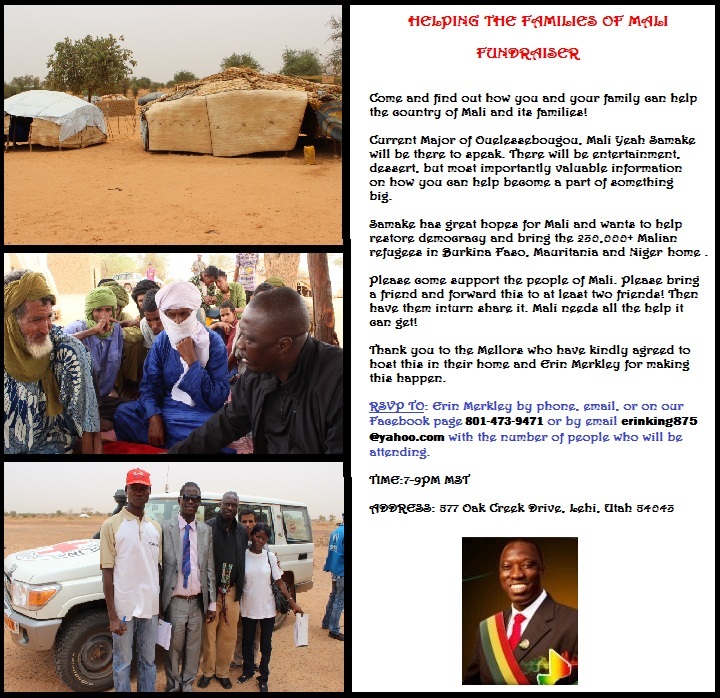
In addition to his briefings to leaders about the status of his country, he also has traveled to Utah to raise money to support the refugees that are suffering in Mali. On Monday he will be in Lehi to host an event that is aimed at raising money and awareness about his people’s situation.

“One of the reasons I am here is to help women and children in those situations,” Samake said. “I’ve been in the refugee camps. I’ve met with the people. I’ve talked with the Red Cross and UNHR and have tried to find the needs of the people. Truly food shortage is significant. But tents are lacking, as well as hygiene kits. And the children that are out of school, they also need a playground and toys to play with.”

So far local businesses have stepped forward to support Samake in his efforts. Nu Skin and Overstock.com have offered their support to him and Lehi resident Erin Merkley is organizing the Monday night event that is open to the public to help support those suffering in Mali. Those wishing to attend the event should contact Merkley at erinking875@yahoo.com.

“Utah can make unique contribution to this because of the connections and ties that so many Utahns have with Mali,” Samake said.

Samake remains hopeful for his country’s future. He also remains optimistic about his chance of becoming the country’s next president. He hopes his current efforts will show the Malians that he genuinely cares for his country and that he has the ability to get things done to get his country on the right track.

“People are looking at me. And this struggle is an opportunity for me to rise up as a leader for my people to see what I can do for the country,” he said.

Just more than 14 million people live in Mali. The annual salary of a skilled worker there is about $1,500. The nation is equal in land size to Texas and California combined.

———————————————————————————————————————————————————————————

WANT TO MAKE DIFFERENCE? NOT DOING ANYTHING MONDAY, JULY 16TH? THEN COME JOIN YEAH IN UTAH AS HE SPEAKS ON HIS FIRST EXPERIENCE MEETING THE DISPLACED MALIAN REFUGEES THAT HAVE NOW FLED TO BURKINA FASO.

CAN’T COME? PLEASE TELL 10 FRIENDS IN UTAH ABOUT THIS EVENT. ALSO, IF YOU CAN, PLEASE DONATE ONLINE AT WWW.SAMAKE2012.COM TO SUPPORT THE REFUGEES.


Together I believe we can make a difference in the lives of the refugees that have been displaced. I pray that soon our Malian brothers and sisters will come home. I cannot imagine the conditions they are being subjected to. The shelter they have is no match for the hot, humid weather mixed with rain showers. The food cannot meet the constant pains of hunger. Imagine sitting 15-20 hours without doing anything, day in and day out. The supplies are running out soon and we need to help continue the aid till we can bring them home. This is not a life and I would never wish it even on my worse enemy.

Please help if you can today. Donate at http://www.samake2012.com

 
2 Comments

Posted by on July 15, 2012 in Past Posts


Tags: , , , , , , , , , , , , , , , , , , , , , , ,

Analyzing Mali’s Refugee Crisis

The one thing that is on my mind these days is the current growing Malian refugee situation. It is hard to watch your fellow man suffer. However, it is harder still when you know they had little to begin with and now everything, including their dignity, is being stripped from them. These people did nothing to deserve the conditions they have been subjected to.

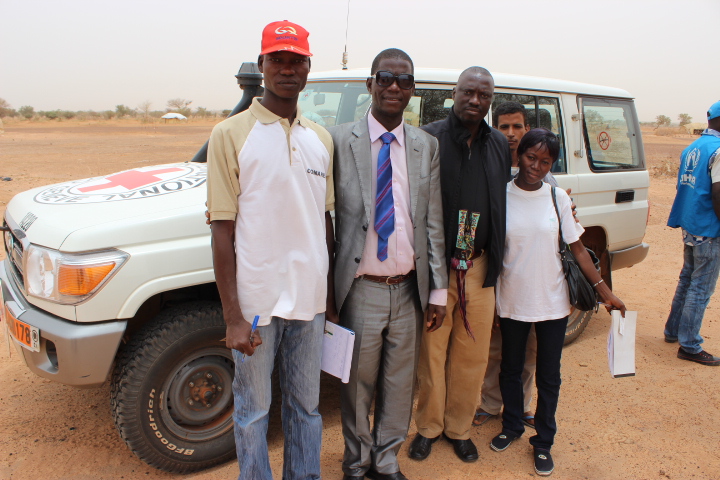
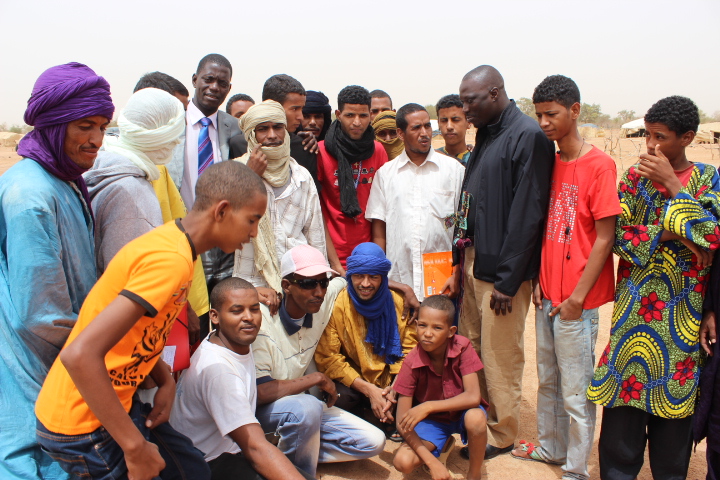
On June 10th, Yeah was a man on a mission. His mission was to truly investigate the conditions of the camp and the state of the refugees living in them, so that he could get the international community and the Malian government more involved.

The camp at Soum

Yeah went to visit the Malian refugees in Burkina Faso. UNHCR (High Commission for Refugees UN), reports 180,060 refugees displaced all over Mali, Burkina Faso, Mauritania and Niger. 65009 refugees are in Burkina Faso as of June 9th 2012. Of these numbers, almost 60% are children. About 38% are aged 18-59 and about 3% are 60 and older. The situation in these camps is getting more and more desperate. The flow of aid is unable to match the need. Yeah went with Malian journalist Yaya Samaké (not a relative) to document the situation and hear firsthand what the refugees and officials concerned with the crisis were saying.

Yeah met with the officials at the Mali Embassy in Burkina Faso. Mali Ambassador to Burkina, Seydou Traoré, admitted that they had not been to visit the Malian refugees situated in Burkina Faso. They told Yeah that the Malian government had not given any aid to be delivered to the refugees. This seems amazing to me that one’s own government does not care two cents as to the plight of their own people. Yeah was the first Malian from Mali to have visited the refugees in Burkina. What is the use of an embassy in Burkina Faso if it does not even serve its people?

Yeah also had the opportunity to meet with the country’s head of UNHCR, Fata Courouma, to better understand the needs of the camp. Yeah visited the Mentao, Damba and Djibo camps which is in the Soum province, 250 km from Burkina’s capital of Ouagadougou.  This area (as of May 18th 2012) according the UNHCR houses 14,506 individuals and 2,472 households.

With the UNHCR/CR-BKF representatives

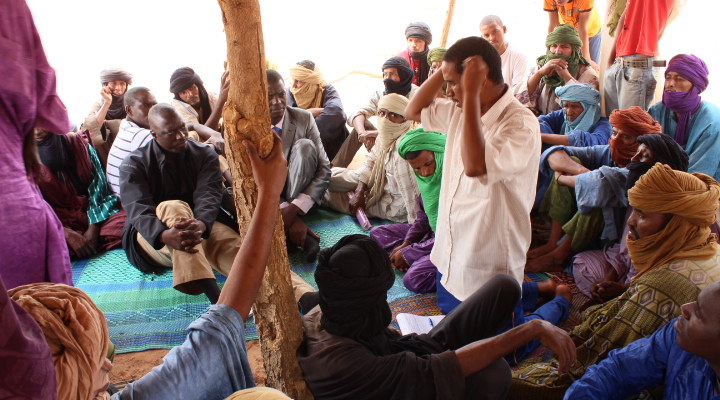
The refugees in these areas hail mainly from the Tombouctou area.  Also among the refugees there are people who have served in the armed forces of Mali. Conditions are getting worse because of the rainy season coming in. The tents available are inadequate to deal with the rainy season. The number one need right now is protection from the elements. Even though food is being served, the rations do not meet the nutritional requirement and are lower than what a person would eat on a daily basis. Children that are displaced are not receiving an education. There are limited health services provided by the UNHCR and the CR-BKF. There are no words to describe the situation in these camps. It is unbelievable that it has come to this and that nothing is being done to help these individuals.

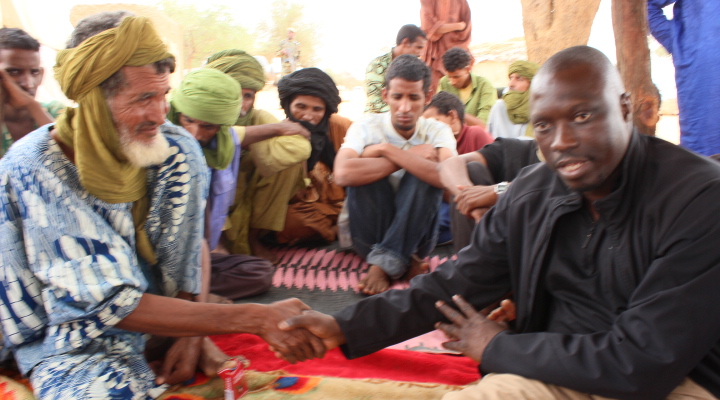
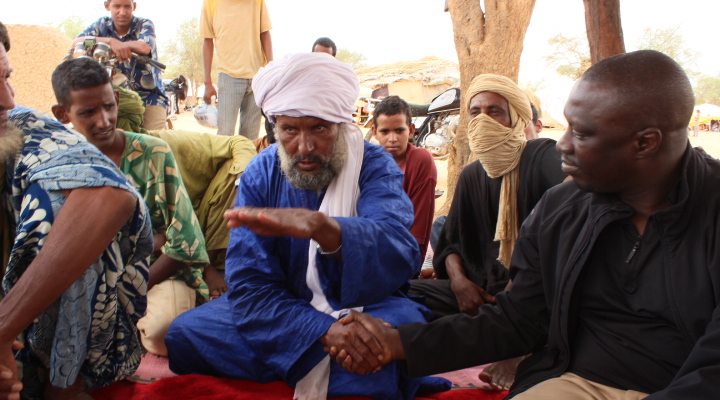
These individuals were so happy that a fellow Malian had finally come to hear what was happening to them in these camps. They expressed their gratitude to the Burkina officials and were frustrated with the Malian government because no one had come to help them. To them, it seemed like they had been forgotten by their own government. Yeah said to them, “I am not come to you on behalf of the Malian government. I came to see you as a brother wounded at the situation as you live. Your suffering is our suffering. Your expectations are not met, not because the government does not have the will, but because the country is almost stopped. Let us all pray for the speedy return of peace, so you can find your homeland. We will always be by your side”.  Yeah promised the camp leaders that he would do more to help them and raise awareness to the growing humanitarian situation.

Aghali Ag Hamidou, the teacher that returned to help

Yeah met one camp representative by the name of Aghali Ag Hamidou , who is from the Tombouctou region and was teaching in Bamako when the fighting broke. He left his job in Bamako and returned to Burkina Faso to help his tribe in the refugee camp. Another camp leader Almahil Ag Almouwak of the South camp said “I prefer the Malian tree to another tree”. Despite the harsh conditions the refugees are under, he was quick to say that Mali will always be their home. They want to return home. He cautioned that not all Tuaregs are rebels and vice versa and cautioned the government to stop treating them as such.

Our Malian brothers and sisters still hold on to the hope that Mali will be reunited and that they will then be able to return home and live in peace.  Speaking through Yeah, they call on the Malian authorities to step up to the plate and help them.

I am glad that Yeah took the opportunity to go see what the refugees have to deal with on a daily basis. The conditions are desperate and are worsening. Now I ask you, imagine not having enough to eat. Imagine being unable to sleep because your tent let water through or because you were simply too hungry. Imagine not knowing what to do with yourself all day, because there simply is nothing to do. Imagine being unable to take care of your family.  Imagine a life where death seems preferable to suffering. Conditions are terrible for the Malian refugees and they are about to get worse as we approach the rainy seasons from July to September.

Donate today to organizations like UNHCR that are on the ground and trying to make a dent in the growing numbers with Operation Mali. Or donate to Samake2012 and specify refugee in the comments field and the funds will go towards the collection Yeah is making for the refugees.

Every little bit helps. Will you help today?

Read Yaya Samake’s article here: FRENCH   TRANSLATED IN ENGLISH

This slideshow requires JavaScript.

 
3 Comments

Posted by on June 20, 2012 in Past Posts


Tags: , , , , , , , , , , , , , ,

A year ago..

A year ago, do you remember what you were exactly doing? June 17th, 2011 is imprinted very well in my mind. This time last year, I was getting off a plane from the US to Mali for a journey that we believed would change our lives and the lives of the Malian people. We came with the firm belief that Yeah could be the change that Mali needed. We believed he could be a fresh start for a country that was stuck in a rut of bad leadership and corrupt practices. Who knew where we would be a year later. All we knew was the journey had begun and was bound to be exciting.

I remember a year ago, my kids would freak out about flies and bugs. Now, a year later they run after them and catch them. A year ago, they would stick very close to each other. Now, they are making other friends. A year ago, they spoke only English. Now their minds are grasping words and phrases in French and Bambara. Instead of having a family of four, they have added our guards, cook and chauffeur as family. My kids have indeed grown since we came last year.

Politically, Mali too has come a long way. Who knew a year ago that what was one of Africa’s most stable democracies would not only be overthrown but the country would be divided. Who knew that almost 200,000 innocents would be displaced and uprooted from a country they had called home for centuries. Who knew that a year of campaigning would ultimately come down to fighting to restore a democracy instead of extend it. Who knew?

Through the year we have campaigned hard in the 4 corners of Mali. We have seen different cultures and traditions all compiled into a Malian. Mali’s diversity contributes to its beauty and uniqueness and we have found ourselves blessed by it. We have had the opportunity to better know Yeah’s culture and his family. I think his family has accepted us even more as they have gotten to truly know us. We have gotten to understand the challenges that Mali faces. We have been blessed to meet medical missions and people that want to make a difference and come to Mali to do just that.

However, we have also experienced history be rewritten and found ourselves amidst a coup. We have ourselves fearing for our family’s safety and in the prayers of many people that feared for us. We are being given an opportunity to continue to make a difference.

Now that we are here a year later, our resolve is no less strong than the day we started. Sure we have a hit a roadblock, but is a journey worth remembering if there are no bumps? Our people must be brought home. Mali needs to become a democracy again, so the people’s voice may be heard again. But the most urgent dilemma is that the North needs to be rid of terrorists. Mali and all Malians will not and should not be compromised anymore.

 
3 Comments

Posted by on June 17, 2012 in Past Posts


Tags: , , , , , , , , , , , , , , , , , , ,

Calm returns to the South while the North Struggles

This past week has passed in relative calm. The capital has almost gotten back to normal and one would find it hard to believe that a coup ever happened. The junta seems to have backed down completely and it’s probably the sweet deal that Sanogo got for himself that is keeping him quiet. However, I am quite surprised other members of the 500-strong junta have remained quiet, which lends to believe that either Sanogo was really the undisputable leader or the rest of the junta is getting something as well that has been undisclosed. Dioncounda remains in Paris and is supposed to return sometime this week. Life continues in much the same way as it did before. Prime Minister Diarra is attempting to fill his role as leader of the country. He has a great responsibility and many are relying on him to push Mali back on track. Yeah had met with him last week to discuss ideas and solutions on how to get Mali’s issues of leadership addressed as well as the issue in the North. Yeah’s take is that without strong leadership and a plan in the South of the country where the government is based, the North’s issues cannot be resolved.

Last week Yeah also gave an exclusive interview to the well known newspaper L’Independent in Mali where he talked of the struggles in Mali. He advised that Mali should not accept ECOWAS troops on Mali’s soil killing Mali’s people in the North. The solution has to be bred on Mali’s soil. Also Yeah encouraged ECOWAS to work with the political class in Mali. With the issue in the North, Yeah said that it is important to involve well off neighbors like Algeria and Mauritania because ECOWAS does not have the logistics and money to support troops despite them wanting to send troops to Mali. Also the stakes are higher for these countries because if rebels/terrorists overflow across their borders, it could cause instability for them. You can read the entire interview here in English: http://samake2012.com/updates/2012/05/interview-with-malian-newspaper-lindependent/#more-1296 or here in French: http://www.maliweb.net/news/interview/2012/05/28/article,69486.html

For the most part, people are just watching and waiting to see what the non-partisan Diarra will do. As I have said before, as long as their leaders don’t make things worse, Malians will put up with it. Diarra seems to be a calming force amidst the chaos. Malians seem to actually heed his words. For the first time yesterday on National TV, he spoke to Segou soldiers on the issue in the North of the country. “I have always said that I do not support war, because it’s war that makes a child an orphan and it’s war that makes a woman a widow. But if we love our country, we must liberate it even if it’s through war, a war that will end the daily wars. A war that will open the door for peace and security because without peace we cannot have security and without security, there will be no prosperity for this nation,” the PM said. He spoke with the most passion and conviction than I have ever seen him have. He talked of how Mali would not concede any part of its land to the rebels. Talk is all well and good. The thing that is most concerning is that Mali currently does not have an equipped army. The 7000-strong army that is reported by statistics websites like CIA may be correct as far as man count. However, the fact remains that the army lacked the arms before the coup and they continue to lack the arms. To send them into the North without the equipment would be like signing their death sentence. Apparently, Western countries, especially America had given ATT a lot of arms and vehicles to fight off the rebels before the coup. Rumor has it that ATT sold or gifted much of this to the rebels themselves when they initially came over to Mali after Libya’s Gaddhafi fell. There are no reports one way or the other to corroborate the story. Fact remains; the army is defenseless and has the manpower but not the equipment to fight.

What Mali needs immediately is strong leadership in the south that has a plan on how to re-unite the country and ultimately gain back the territories in the North. The Tuaregs are a minority and not even they are in control right now. Control seems to be shared between Ansar Dine, MUJAO, AQIM and MNLA, all terrorist factions. So while the South seems to be gaining some control, the North is struggling with a terrorist problem and a refugee issue.

UNICEF despite increasing the aid it is providing has been warning about the sanitary conditions at the camps as well as the demand outweighing the supply. Ultimately, it will be the women and children that will bear the brunt of this refugee crisis. This refugee crisis started with the drought but has been intensified by the crisis in Mali. The problem has been overlooked long enough as the world’s attentions focused in South Bamako. In addition governments of Mauritania, Algeria, Senegal and Burkina Faso also have to deal with the refugees that fled across the border. One country’s crisis is becoming West Africa’s dilemma. This is just one big mess and it needs the international community to bring light to the growing humanitarian crisis. On the other hand there are terrorist groups operating freely in the North. They are restricting aid and making life very hard for residents by imposing Sharia law. There have also been reports that they are damaging World Heritage sites in Tombouctou that have been around for centuries. Imagine the destruction of the Great Wall of China or the Taj Mahal. As an Indian, I would be angered if anything happened to a symbol of my culture. Even the youth of the North have mobilized themselves, fed up with the lack of leadership from Bamako.

Finally, given ECOWAS’ failed track record to help bring civilian rule to Mali, ECOWAS has designated a new representative from the country of Benin. Let’s hope the new leadership will not bully Mali and cause more issues.

Strong leadership first will allow Mali to resolve this crisis and attempt to resolve the growing issue in the North. The question remains, will Prime Minister Diarra be that stabilizing force that Mali desperately needs and will ECOWAS finally include all political forces in Mali rather than enforcing their will.

 
Leave a comment

Posted by on June 2, 2012 in Past Posts


Tags: , , , , , , , , , , , , , , , , , , , ,

Mali’s Muddle

This past week has been a huge political muddle. May 22nd was to spell the last day of office for interim President Dioncounda Traoré. A deal brokered by the African nation’s body ECOWAS sought to extend his term for 12 months. Now Dioncounda would have limited powers and the main running of the country would fall in the hands of the Prime Minister Cheick Modibo Diarra.

On Monday, protesters unhappy with the forced decision to keep Dioncounda marched on Mali’s palace. There in the heat of the moment, the 70-year old Dioncounda was injured and admitted to the Mali hospital with head injuries. Now people are saying the junta that was supposed to be protecting the President let these protestors in. On the other side, we have also heard that there was a scheduled meeting between Dioncounda and 10 individuals that represented opposing factions. When these 10 individuals came to meet the President and were waved in by the guards, the protesters pushed past as well. Either story while the second may remove the junta’s involvement are hard to corroborate and point to the finer meaning that not even the highest office in the country is safe from protest.

As Bamako watched the news of this attack spread, we were in disbelief. While I am a big believer in democratic process and making your opinion heard, I am also of the belief that human beings need to act like human beings and not animals. In addition, in a society that reveres its elderly, for a 70-year old individual to be assaulted by youth is something that Malians do not take kindly to. That next morning, in secrecy Dioncounda was flown to Paris to be admitted for further testing. That evening, there was another protest held which claimed that Sanogo would be the new President. This protest was only attended by a few 1000 compared to the tens of thousands the previous day. This could mean one of two things. One, many people were shocked that the events of the previous day got so out of hand and also many people felt that Sanogo betrayed them when he took a deal with ECOWAS that bestowed him with an ex-President’s privileges. Sanogo, for his part, other than condemning the violence of the protests, has remained quiet. He as brokered a pretty sweet deal for himself. He would get paid $10000/month (5 million cfa), a house, two cars and a security detail. So the gift he is getting for bringing so much insecurity is very big. In a country so poor, one can only imagine how anyone can get so much money when the average Malian makes less than a $1 a day. The question that also is high on every ones minds is that Sanogo has benefitted but what about the 500+ odd men under the junta. If they feel that Sanogo has betrayed them, then things could get ugly.

This past week Yeah met with the Prime Minister to discuss the ongoing situation. The Prime Minister has condemned the actions of the mob and called on people to be calm using the Bambara word “Sabali” which means “patience” several times in an address to the nation. Yeah also had an opportunity to talk with CNN’s Suzanne Malveaux on the issues in Mali. Take a listen at CNN below. You can also find this on http://samake2012.com/updates/

http://newsroom.blogs.cnn.com/2012/05/24/amid-chaos-malians-hope-to-get-their-nation-back-on-track/

The North continues to remain in the hands of rebels and the ties that these groups are building are very dangerous to Mali’s stability. Mali’s AZAWAD last week even installed their own President over the North. There has been talk of Mali letting these three regions go. If that happened, I think the outcry in Mali would be huge. These territories not only house the Tuaregs that want their independence but also many other ethnic groups, of which the Tuaregs are a minority. By allowing an independent state to emerge, Mali would be allowing a territory in which groups similar to the Taliban will emerge. In essence Al-Qaeda would be able to get a new playground to harvest various training camps and illegal activities. The entire world will pay the price if the North becomes another Al-Qaeda festering pot. In all this, Malians will pay the heaviest price. With Sharia law already established in Tombouctou, Malians are already being suppressed. Malians in the South need to focus their attentions on the Northern regions. Aid is not the only thing the North needs. It needs freedom from groups attempting to take away civil liberties. If the world wants to get involved it needs to be putting pressure on these groups to pull out. Yeah spoke with CNN’s Erin Burnett about the Northern issue in Mali.

In this entire ruckus, the one thing that remains as forgotten today as it was two months ago is the growing refugee situation. The situation is worse today as the numbers continue to climb. People are living in despicable conditions and while the aid is coming in more now than before, it cannot meet the growing demand. It amazes me that when the earthquake happened in Haiti, the American celebrities put on a great fundraiser and raised a lot of money to benefit Haiti. Probably because Haiti was closer to home. However, the refugee situation has not gained the support of celebrities despite Angelina Jolie being called as a special envoy for the UN High Commission for Refugees. The need is great, the supply is small. Next week, Yeah plans to go to Mopti where some of the refugees are and then later to Burkina Faso. The hope is to assess the growing need and then provide the refugees with some much needed food.

The one thing that never fails to amaze me is the tenacious strength of the Malian people. Through all this, they continue to build their lives, taking in stride the changing forces. As noted before, their faith in their politicians is very low and their belief is as long as the politicians don’t make their lives worse, life will go on. Here it is hard for people to look to the future when their present is so filled with turmoil and hardship. But the Malian people will prevail like they have before. They deserve a much needed break. They definitely deserve better leaders who will give their needs a priority. Mali’s mess cannot be solved by self-serving politicians. It needs honest leadership!

 
Leave a comment

Posted by on May 26, 2012 in Past Posts


Tags: , , , , , , , , , , , , , , , , , , , , , , , , , ,